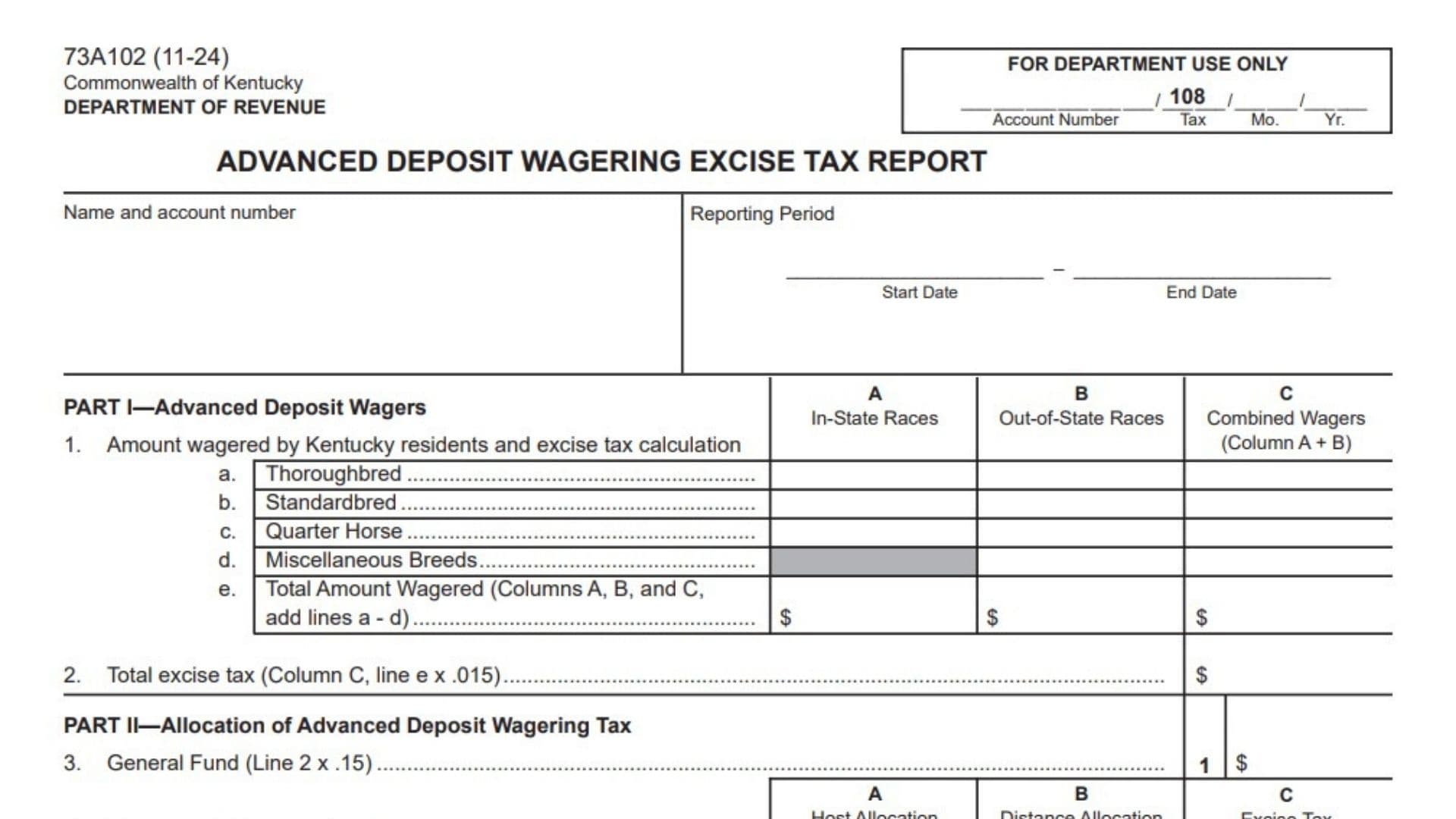
Kentucky Form 73A102, the Advanced Deposit Wagering Excise Tax Report, is used to report advanced deposit wagers made by Kentucky residents and calculate the Kentucky excise tax associated with those wagers. The report separates wagers according to whether the underlying race took place in Kentucky or outside Kentucky and further classifies the wagers by racing breed: Thoroughbred, Standardbred, Quarter Horse, or Miscellaneous Breeds. After determining the total wagers and calculating the 1.5% excise tax, the form divides the tax between the General Fund and allocations associated with Kentucky racetracks. The track portion is determined through host and distance allocation rules that consider the breed of the race, the resident’s registered ZIP code, proximity to a Kentucky track, and which track has host status. The report also serves as a reconciliation because the total allocations in Part II must equal the total excise tax calculated in Part I. Completing the form accurately is important because the reported wager amounts determine both the tax due and how that tax is distributed among the General Fund and eligible Kentucky racing facilities.
How To File Form 73A102
Prepare Form 73A102 in duplicate.
Send the original report, together with any required tax payment, to:
Kentucky Department of Revenue
Frankfort, Kentucky 40619
Make any check for tax due payable to the Kentucky State Treasurer.
A copy of the report must also be submitted by email to the Kentucky Horse Racing & Gaming Corporation at:
The tax must be remitted weekly. Payment is due no later than the first business day of the week immediately following the week in which the wagers forming the tax base were received.
For purposes of this reporting requirement, a race week begins on Monday and ends on Sunday.
Before completing the report, prepare records showing:
- The reporting period.
- The taxpayer’s name and account number.
- Wagers placed by Kentucky residents.
- Whether each wager involved an in-state or out-of-state race.
- The breed associated with each race.
- The registered ZIP code of each Kentucky resident at the time of the wager when distance allocation is necessary.
- The Kentucky tracks located within 25 miles of the applicable ZIP-code center point.
- The host track designated for each breed and applicable date.
- Wagers allocated to each Kentucky racetrack.
- Calculations supporting the General Fund allocation.
- Host allocation calculations.
- Distance allocation calculations.
- Total excise tax due.

How To Complete Form 73A102
Taxpayer And Reporting Period Information
Name and Account Number
Enter the name of the taxpayer or reporting entity and the applicable account number.
Make sure the account information corresponds with the entity responsible for filing the Advanced Deposit Wagering Excise Tax Report.
Reporting Period — Start Date
Enter the first date covered by the report.
Because the tax remittance requirements operate on a weekly basis, make sure the reporting period corresponds with the wagers being reported.
Reporting Period — End Date
Enter the final date covered by the report.
Review the underlying wagering records to make sure wagers outside the stated period are not included.
For Department Use Only
Do not complete the box marked for Department use. The account, tax, month, and year information in this area is reserved for processing by the Kentucky Department of Revenue.
Part I: Advanced Deposit Wagers
Part I reports the amount wagered by Kentucky residents and calculates the total excise tax.
The section uses three columns:
- Column A — In-State Races
- Column B — Out-of-State Races
- Column C — Combined Wagers
For each breed, first separate wagers according to whether the race was conducted in Kentucky or outside Kentucky. Column C then combines the amounts reported in Columns A and B.
Classifying Wagers By Breed
Wagers must be classified according to the breed of race conducted by the source track.
Use the four categories shown on the form:
- Thoroughbred.
- Standardbred.
- Quarter Horse.
- Miscellaneous Breeds.
Races identified as mixed breed, or any breed that is not Thoroughbred, Standardbred, or Quarter Horse, belong in the Miscellaneous Breeds category.
Miscellaneous Breeds should not have any amount reported as an in-state race on this form.
Line 1a: Thoroughbred
In Column A, enter the amount Kentucky residents wagered on Thoroughbred races conducted in Kentucky.
In Column B, enter the amount Kentucky residents wagered on Thoroughbred races conducted outside Kentucky.
Add Columns A and B and enter the combined Thoroughbred wager amount in Column C.
Line 1b: Standardbred
In Column A, report Kentucky-resident wagers on Standardbred races conducted in Kentucky.
In Column B, report Kentucky-resident wagers on Standardbred races conducted outside Kentucky.
Add the two amounts and enter the result in Column C.
Line 1c: Quarter Horse
Enter Kentucky-resident wagers on Kentucky Quarter Horse races in Column A.
Enter Kentucky-resident wagers on out-of-state Quarter Horse races in Column B.
Add Columns A and B and enter the combined amount in Column C.
Line 1d: Miscellaneous Breeds
Report wagers on mixed races or breeds other than Thoroughbred, Standardbred, or Quarter Horse.
The form instructions state that Miscellaneous Breeds do not have wagers reported under In-State Races. Therefore, this category should not have an amount in Column A.
Enter applicable out-of-state Miscellaneous Breeds wagers in Column B and carry the combined amount to Column C.
Line 1e: Total Amount Wagered
Total lines 1a through 1d separately for each column.
For Column A:
Add Column A, lines 1a through 1d.
For Column B:
Add Column B, lines 1a through 1d.
For Column C:
Add Column C, lines 1a through 1d.
Column C should also represent the combined total of the Column A and Column B wagering amounts.
Line 2: Total Excise Tax
Multiply the total combined wagers from Column C, line 1e by 1.5%.
Use:
Column C, Line 1e × 0.015 = Line 2
Enter the resulting total excise tax on line 2.
This amount becomes the total tax that must be allocated in Part II.
Part II: Allocation of Advanced Deposit Wagering Tax
Part II determines how the tax calculated on line 2 is distributed.
Part II first assigns 15% of the tax to the General Fund. The remaining allocation associated with racing is calculated using host and distance allocation rules.
An important distinction is that the columns in Part II do not have the same meaning as the columns in Part I.
In Part II:
- Column A is Host Allocation.
- Column B is Distance Allocation.
- Column C is Excise Tax, calculated by adding Columns A and B.
For the racing allocations, both the host and distance formulas use:
Allocated Wagers × 0.015 × 0.85
The 0.015 factor applies the 1.5% excise tax, while the 0.85 factor represents the 85% portion allocated after the 15% General Fund amount.
General Fund Allocation
Line 3: General Fund
Multiply the total excise tax from line 2 by 15%.
Use:
Line 2 × 0.15 = Line 3
Enter the result as the General Fund allocation.
How Host And Distance Allocation Work
Before completing the individual track lines, determine whether the wagers belong in the Host Allocation or Distance Allocation column.
In-State Races
When a Kentucky resident places a wager on a race conducted in Kentucky, allocate the wager to the track conducting that race.
The instructions indicate that this track should also have host status.
Out-of-State Races
For an out-of-state race, Distance Allocation is the default when the resident is within 25 miles of an applicable Kentucky track.
The allocation is breed-specific.
Use the resident’s registered ZIP code at the time the wager was made when determining the applicable distance.
The distance calculation must use the ZIP-code center points provided by the Kentucky Horse Racing & Gaming Corporation.
If the resident does not live within 25 miles of a Kentucky track, allocate the wager to the track that has host status for that particular breed.
If the resident is outside the 25-mile area and no Kentucky track has host status for that breed on the applicable date, split the wagers equally among all Kentucky tracks associated with that breed and report the resulting allocations in the Host Allocation column.
Allocation for Thoroughbred Racing
The Thoroughbred section contains five Kentucky tracks:
- Churchill Downs.
- Ellis Park.
- Keeneland.
- Kentucky Downs.
- Turfway Park.
Complete Columns A, B, and C for each applicable track.
Line 4a: Churchill Downs
Enter the Thoroughbred amount assigned to Churchill Downs under the Host Allocation rules in Column A.
Calculate:
Applicable Host Wagers × 0.015 × 0.85
If applicable wagers qualify for Distance Allocation to Churchill Downs, calculate the corresponding amount in Column B using:
Applicable Distance Wagers × 0.015 × 0.85
Add Columns A and B and enter the total in Column C.
Line 4b: Ellis Park
Calculate any Host Allocation attributable to Ellis Park in Column A and any Distance Allocation in Column B.
Add the two allocation amounts and enter the total in Column C.
Line 4c: Keeneland
Enter the applicable Thoroughbred Host Allocation for Keeneland in Column A.
Enter the applicable Distance Allocation in Column B.
Add Columns A and B and report the combined excise tax in Column C.
Line 4d: Kentucky Downs
Calculate the amounts allocated to Kentucky Downs using the applicable host and distance rules.
Enter Host Allocation in Column A, Distance Allocation in Column B, and their combined total in Column C.
Line 4e: Turfway Park
Enter the applicable Host Allocation in Column A and Distance Allocation in Column B.
Add those amounts and enter the result in Column C.
Line 5: Total Allocation for Thoroughbred Racing
Add lines 4a through 4e separately for each column.
For Column A, total all Thoroughbred Host Allocations.
For Column B, total all Thoroughbred Distance Allocations.
For Column C, total the excise tax allocated to all Thoroughbred tracks.
Allocation for Standardbred Racing
The Standardbred section includes:
- The Red Mile.
- Oak Grove Racing.
- Cumberland Run (ECL Corbin).
Line 6a: The Red Mile
Enter any Standardbred Host Allocation attributable to The Red Mile in Column A.
Enter any qualifying Distance Allocation in Column B.
Add Columns A and B and report the total in Column C.
Line 6b: Oak Grove Racing
Calculate the applicable Host Allocation and enter it in Column A.
Calculate any applicable Distance Allocation and enter it in Column B.
Add the amounts and enter the result in Column C.
Line 6c: Cumberland Run (ECL Corbin)
Enter the applicable Host Allocation in Column A and Distance Allocation in Column B.
Add both amounts and report the combined allocation in Column C.
Line 7: Total Allocation for Standardbred Racing
Add lines 6a through 6c for each column.
Column A should show the total Standardbred Host Allocation.
Column B should show the total Standardbred Distance Allocation.
Column C should show the total Standardbred excise tax allocation.
Allocation for Quarter Horse Racing
The form lists Sandy Ridge Racing for Quarter Horse allocation.
Line 8a: Sandy Ridge Racing
Enter the applicable Quarter Horse Host Allocation in Column A.
Enter the applicable Quarter Horse Distance Allocation in Column B.
For each allocation, use:
Applicable Wagers × 0.015 × 0.85
Add Columns A and B and report the total in Column C.
Line 9: Total Allocation for Quarter Horse Racing
Because only Sandy Ridge Racing appears in this section, carry the amounts from line 8a into the corresponding columns on line 9.
The form specifically directs the filer to enter line 8a for the total Quarter Horse allocation.
Allocation of Miscellaneous Breeds
Miscellaneous Breeds include races classified as mixed or races involving breeds other than Thoroughbred, Standardbred, or Quarter Horse.
The form provides allocation rows for:
- Churchill Downs.
- Ellis Park.
- Keeneland.
- Kentucky Downs.
- The Red Mile.
- Oak Grove Racing.
- Turfway Park.
- Cumberland Run (ECL Corbin).
- Sandy Ridge Racing.
Miscellaneous Breed allocations have additional rules for situations involving multiple nearby tracks or no nearby Kentucky track.
Miscellaneous Breed Distance Allocation
If the resident’s registered ZIP code is within 25 miles of multiple Kentucky tracks, divide the applicable Miscellaneous Breeds wagers equally among all tracks within 25 miles.
Report those amounts in the Distance Allocation column.
Miscellaneous Breed Host Allocation
If the resident does not live within 25 miles of a Kentucky track, divide Miscellaneous Breeds wagers equally among all the listed tracks.
Report those amounts in the Host Allocation column.
Line 10a: Churchill Downs
Enter any Miscellaneous Breeds Host Allocation in Column A and Distance Allocation in Column B.
Add the two amounts for Column C.
Line 10b: Ellis Park
Enter the applicable Host and Distance allocations and total them in Column C.
Line 10c: Keeneland
Report the applicable Miscellaneous Breeds amounts for Keeneland in Columns A and B, then add them for Column C.
Line 10d: Kentucky Downs
Enter the Host Allocation and Distance Allocation attributable to Kentucky Downs and total them in Column C.
Line 10e: The Red Mile
Complete the Host and Distance allocation amounts for The Red Mile and add them in Column C.
Line 10f: Oak Grove Racing
Enter the applicable allocation amounts in Columns A and B and combine them in Column C.
Line 10g: Turfway Park
Report the applicable Host and Distance allocations for Turfway Park and enter their sum in Column C.
Line 10h: Cumberland Run (ECL Corbin)
Enter the applicable Miscellaneous Breeds Host and Distance allocations and add them for Column C.
Line 10i: Sandy Ridge Racing
Report the applicable Host Allocation in Column A and Distance Allocation in Column B.
Add them and enter the total in Column C.
Line 11: Total Allocation for Miscellaneous Breeds
Add lines 10a through 10i separately for Columns A, B, and C.
Column A represents the total Miscellaneous Breeds Host Allocation.
Column B represents the total Miscellaneous Breeds Distance Allocation.
Column C represents the total excise tax allocated for Miscellaneous Breeds.
Grand Total And Reconciliation
Line 12: Grand Total
Add the Column C amounts from:
- Line 3, General Fund.
- Line 5, Thoroughbred Racing.
- Line 7, Standardbred Racing.
- Line 9, Quarter Horse Racing.
- Line 11, Miscellaneous Breeds.
The calculation is:
Line 3 + Line 5, Column C + Line 7, Column C + Line 9, Column C + Line 11, Column C = Line 12
The amount on line 12 should equal the total excise tax shown on line 2.
If line 12 does not equal line 2, review the General Fund amount, individual track allocations, breed classifications, and Host/Distance calculations before filing.
Detailed Distance Allocation Rules
Distance Allocation applies to out-of-state wagers based on the resident’s registered ZIP code and the breed of the race.
Determine whether a Kentucky track for the applicable breed is within 25 miles of the resident’s registered ZIP code at the time the wager was placed.
Use the ZIP-code center-point information supplied by the Kentucky Horse Racing & Gaming Corporation when measuring this distance.
When an eligible track is within 25 miles, allocate the applicable wager to that track under the Distance Allocation column.
For Miscellaneous Breeds, if multiple tracks are within 25 miles, divide the wagers equally among all qualifying tracks.
Detailed Host Allocation Rules
If a Kentucky resident placing an out-of-state wager does not live within 25 miles of an applicable Kentucky track, use the host-track rules.
Allocate the wager to the Kentucky track identified as the host track for that breed by the Kentucky Horse Racing & Gaming Corporation for the applicable date.
For Thoroughbred, Standardbred, and Quarter Horse races, if no host track has been identified for that date and the resident is not within 25 miles of a Kentucky track, divide the wager equally among all Kentucky tracks for the applicable breed.
Record those allocations in the Host Allocation column.
For Miscellaneous Breeds, when the resident does not live within 25 miles of a Kentucky track, divide the wagers equally among all applicable tracks and report them under Host Allocation.
Understanding the Allocation Examples
The instructions provide several Thoroughbred examples to demonstrate how the distance and host rules interact.
Host Track Exists and Nearby Track Exists
If Churchill Downs is the host but the resident is within 25 miles of Keeneland, the allocation goes to Keeneland.
The distance rule takes priority for that out-of-state wager.
No Host Track and Nearby Track Exists
If there is no designated host track for the date but the resident is within 25 miles of Keeneland, the allocation still goes to Keeneland.
Host Track Exists but No Nearby Track Exists
If Churchill Downs is the host and the resident is not within 25 miles of a Kentucky track, the allocation goes to Churchill Downs.
No Host Track and No Nearby Track Exists
If there is no host track and the resident is not within 25 miles of a Kentucky track, divide the wager among all Thoroughbred tracks.
Report those amounts under Host Allocation.
Certification And Contact Information
After completing Parts I and II, an authorized representative must certify the report.
The certification states that the report and any accompanying schedules are, to the best of the signer’s knowledge and belief, true and correct.
Representative
Enter the name of the representative responsible for certifying the report.
Title
Enter the representative’s business or organizational title.
Signature
The authorized representative must sign the report.
Date
Enter the date the report is signed.
Email Address
Provide an email address where the representative or reporting entity can be contacted.
Telephone Number
Enter a telephone number for questions concerning the report.
Payment And Submission Instructions
If tax is due, make the check payable to:
Kentucky State Treasurer
Mail the original report and payment to:
Department of Revenue
Frankfort, Kentucky 40619
A duplicate copy of the report must also be emailed to the Kentucky Horse Racing & Gaming Corporation at:
The tax must be remitted no later than the first business day of the week following the week during which the taxable wagers were received.
For reporting purposes, the race week runs from Monday through Sunday.
Interest And Penalties
Interest on Unpaid Tax
If tax remains unpaid after its original due date, interest may be assessed from the original due date through the date the tax is paid.
The applicable tax interest rate is determined under Kentucky law.
Late Payment Penalty
If the tax shown on line 2 is not paid by its original due date, a late-payment penalty may be assessed.
The penalty is 2% of the tax due for each 30-day period or part of a 30-day period that the tax remains unpaid.
The late-payment penalty cannot exceed 20% of the tax due.
The minimum penalty is $10.
Late Filing Penalty
A separate penalty may apply if the report is not filed by its due date or an applicable extended due date.
The late-filing penalty may equal 2% of the total tax due for every 30 days or portion of 30 days that the return remains unfiled.
The maximum late-filing penalty is 20%, and the minimum penalty is $10.
Additional penalties may also apply in circumstances involving negligence, failure to file, fraud, or other violations.
Penalties may be reduced or waived when sufficient reasonable cause can be established. Interest is not included in this potential penalty reduction or waiver.
Final Review Before Filing
- Confirm that the taxpayer’s name and account number are correct.
- Verify the reporting-period start date.
- Verify the reporting-period end date.
- Leave the Department-use-only section for the Department of Revenue.
- Include only wagers placed by Kentucky residents.
- Separate in-state race wagers from out-of-state race wagers.
- Classify every wager according to the breed of the source race.
- Report Thoroughbred wagers on line 1a.
- Report Standardbred wagers on line 1b.
- Report Quarter Horse wagers on line 1c.
- Report mixed and other breeds on line 1d as Miscellaneous Breeds.
- Do not report Miscellaneous Breeds wagers as in-state race wagers.
- Add lines 1a through 1d correctly for each column on line 1e.
- Confirm that Column C combines Columns A and B.
- Multiply Column C, line 1e by 1.5% to calculate line 2.
- Multiply line 2 by 15% for the General Fund amount on line 3.
- Identify the correct breed before allocating the remaining racing tax.
- Use the resident’s registered ZIP code at the time of the wager for distance determinations.
- Use the required ZIP-code center points when determining the 25-mile distance.
- Use Distance Allocation when the applicable out-of-state wager qualifies under the 25-mile rule.
- Use Host Allocation when the resident is not within 25 miles and an applicable host track exists.
- Split wagers correctly when no host track exists and no applicable track is within 25 miles.
- For Miscellaneous Breeds, split wagers equally among multiple tracks within 25 miles when required.
- For Miscellaneous Breeds outside the 25-mile area, divide wagers among the applicable tracks as instructed.
- Calculate each Host Allocation as applicable wagers × 0.015 × 0.85.
- Calculate each Distance Allocation as applicable wagers × 0.015 × 0.85.
- Add Host and Distance allocations to determine Column C for each track.
- Total Thoroughbred allocations correctly on line 5.
- Total Standardbred allocations correctly on line 7.
- Carry the Quarter Horse allocation to line 9 correctly.
- Total Miscellaneous Breeds allocations correctly on line 11.
- Add lines 3, 5, 7, 9, and 11 in Column C for line 12.
- Confirm that line 12 equals the total excise tax on line 2.
- Enter the representative’s name.
- Enter the representative’s title.
- Have the authorized representative sign the report.
- Enter the date signed.
- Provide an email address.
- Provide a telephone number.
- Prepare the report in duplicate.
- Make any required check payable to the Kentucky State Treasurer.
- Send the original report and payment to the Kentucky Department of Revenue.
- Email a copy to the Kentucky Horse Racing & Gaming Corporation.
- Make the weekly remittance no later than the first business day following the applicable race week.