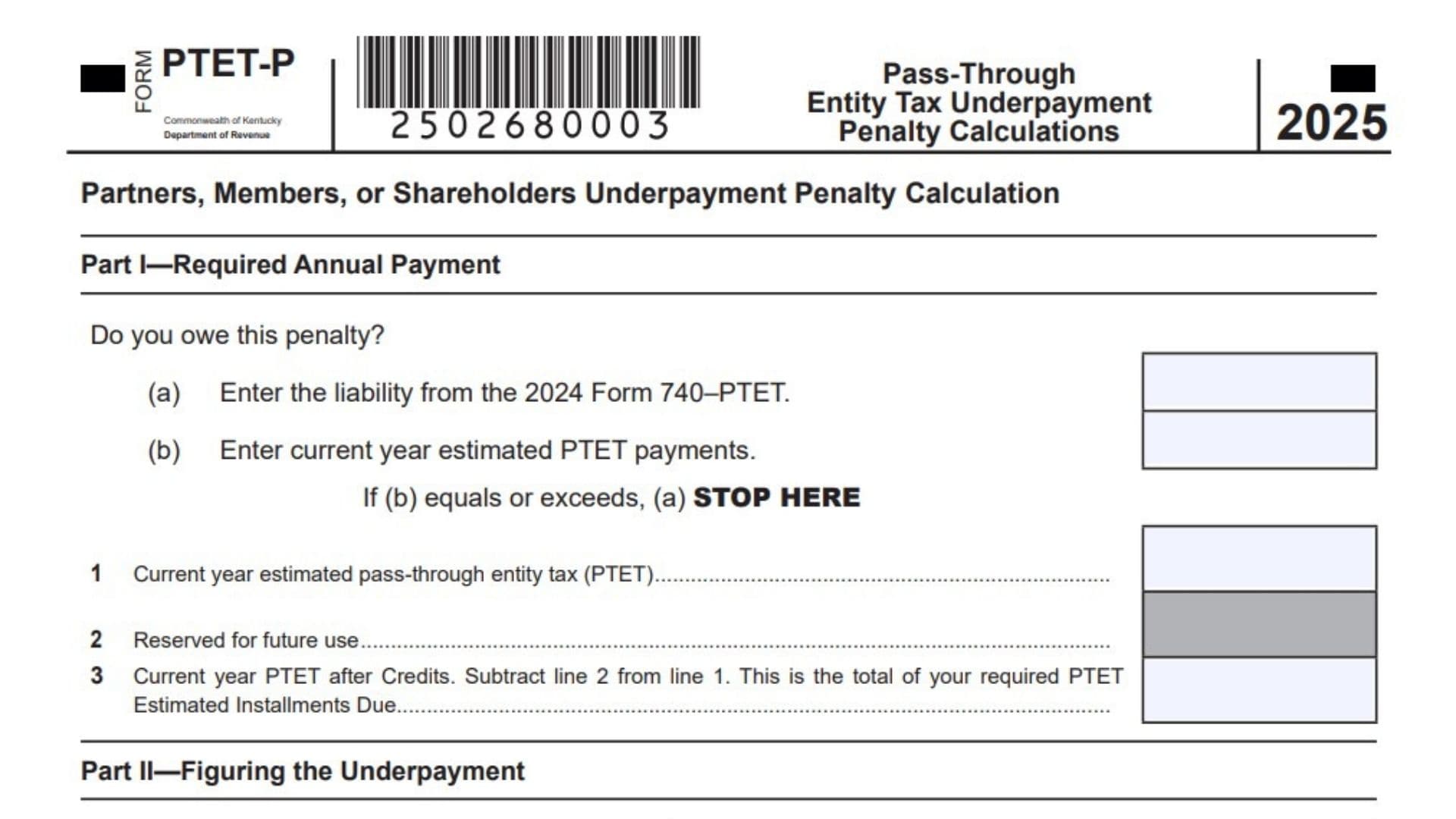
Form PTET-P (Form 40A201PTET-P), issued by the Commonwealth of Kentucky Department of Revenue, is the official tax schedule used by pass-through entities to determine whether they owe an underpayment penalty on estimated pass-through entity tax payments and to calculate the exact penalty amount. When partnerships, S-corporations, or limited liability entities elect to pay Kentucky income tax at the entity level on behalf of their partners, members, or shareholders, state law requires timely quarterly estimated tax installments throughout the tax year. Form PTET-P exists to verify whether the required minimum payments were remitted on schedule across all four payment quarters. The form collects critical figures, including total elective tax liabilities, allowable credits, payment application dates, daily period breakdowns across applicable statutory interest and penalty rates, and cumulative overpayments or underpayments per installment quarter. Accurately filling out this form ensures that an entity complies with Kentucky Revised Statutes, avoids unnecessary additional penalties, and properly reconciles underpayment assessments directly on the main entity return.
How To File Form PTET-P
Kentucky Form PTET-P is an attachment schedule rather than an independent tax return. If an entity determines that an estimated tax penalty is owed or if the department requires supporting calculations for elective pass-through tax payments, the completed form must be submitted directly alongside Kentucky Form 740-PTET (Kentucky Pass-Through Entity Tax Return).
Before beginning the form, tax preparers and business owners should gather the following records:
- The prior tax year’s Form 740-PTET to review previous liability numbers.
- The current tax year’s finalized or estimated Form 740-PTET figures, including net distributive income computations and eligible credits.
- Complete payment records, electronic receipt dates, canceled checks, and confirmation vouchers (such as Form 740-PTET-ES payments) showing the exact dates and amounts remitted for each quarterly installment period.
- Relevant accounting schedules detailing whether the entity operates on a standard calendar year or an approved fiscal tax year.
Preliminary Test: Do You Owe This Penalty?
Before completing the multi-part calculation schedules, fill out the preliminary screening questions at the top of the form to determine whether you are exempt from the penalty under statutory safe-harbor provisions.
Box (a): Prior Year Liability
Enter the total tax liability reported on the preceding year’s Form 740-PTET return.
Box (b): Current Year Estimated Payments
Enter the sum of all estimated pass-through entity tax payments made for the current tax year.
Screening Rule
Compare the amount entered in Box (b) to Box (a). If your current year estimated payments in Box (b) equal or exceed your prior year liability in Box (a), you meet the safe-harbor threshold and do not owe an underpayment penalty. You may stop here and do not need to fill out the remaining sections of the form. If Box (b) is less than Box (a), continue to Part I.

How To Complete Kentucky Form PTET-P
Form PTET-P is divided into three structured parts that guide filers through determining the required annual amount, allocating quarterly payments, and computing daily interest-based penalty charges.
Part I: Required Annual Payment
Part I establishes the net pass-through entity tax balance for the current tax year that must be distributed across the quarterly installment periods.
Line 1: Current Year Estimated Pass-Through Entity Tax
Enter the total current year elective pass-through entity tax liability before subtracting credits.
Line 2: Credits / Reserved For Future Use
Enter any allowable nonrefundable tax credits applicable to the entity’s liability. If the form indicates this line is reserved for future administrative updates, enter zero or leave blank as instructed for the specific filing year.
Line 3: Current Year PTET After Credits
Subtract Line 2 from Line 1. The resulting balance represents the total required estimated pass-through entity tax liability that must be paid across the installment periods.
Part II: Figuring The Underpayment
Part II evaluates each quarterly installment across four columns (Columns A, B, C, and D), corresponding to the first, second, third, and fourth payment quarters. You must complete Lines 7 through 13 entirely for one column before advancing to the next column.
Line 4: Installment Due Dates
Enter the statutory due date for each installment period across Columns A through D. For calendar-year filers, these dates represent the 15th day of the 4th month (April 15), 6th month (June 15), 9th month (September 15) of the tax year, and the 15th day of the month following the close of the tax year (January 15). Fiscal-year entities must enter corresponding dates based on the 15th day of their 4th, 6th, and 9th fiscal months, and the 15th day of the month following fiscal year-end.
Line 5: Required PTET Installments
Calculate 25 percent (0.25) of the total annual liability reported on Line 3, and enter this identical required quarterly installment amount in each column from Column A through Column D.
Line 6: Estimated PTET Tax Paid Or Credited
Enter the actual amount of estimated tax paid or credited for each specific quarterly period. For Column A only, carry this payment amount directly down to Line 10.
Line 7: Prior Column Overpayment Carryforward
Enter the overpayment amount carried forward from Line 13 of the preceding column. Leave Column A blank.
Line 8: Total Payments And Credits Available
Add Line 6 and Line 7 within each column to establish the total available tax credits and payments for the period.
Line 9: Prior Column Unapplied Underpayment
Enter the combined total of unapplied amounts from Line 11 and Line 12 of the preceding column. Leave Column A blank.
Line 10: Net Available Payment
Subtract Line 9 from Line 8. If the result is zero or less, enter zero. For Column A only, enter the exact payment figure from Line 6.
Line 11: Unapplied Prior Underpayment Carryover
If the amount on Line 10 is zero, subtract Line 8 from Line 9 and enter the difference here to carry forward to the next period. If Line 10 is greater than zero, enter zero.
Line 12: PTET Underpayment
Compare Line 10 to Line 5. If Line 10 is less than or equal to Line 5, subtract Line 10 from Line 5 and enter the result here. This represents your underpayment for the quarter. Once entered, move to Line 7 of the next column. If Line 10 is greater than Line 5, enter zero and proceed to Line 13.
Line 13: PTET Overpayment
If Line 5 is less than Line 10, subtract Line 5 from Line 10 and enter the excess payment amount here. Carry this overpayment figure to Line 7 of the subsequent column. If Line 5 is equal to or greater than Line 10, enter zero.
Part III: Figuring The PTET Underpayment Penalty
Part III applies statutory penalty rates based on the number of days each quarterly underpayment remained outstanding across relevant calendar interest periods.
Line 14: Payment Date Or Extended Cut-Off Date
For each quarterly column that reflects an underpayment on Line 12, enter the date the specific installment was paid in full or the 15th day of the 4th month following the close of the tax year, whichever date occurred earlier.
Line 15: Total Underpayment Duration In Days
Calculate and enter the total number of days elapsed from the statutory installment due date entered on Line 4 to the payment or cut-off date entered on Line 14 for each column.
Line 16: First Period Days
Enter the portion of days from Line 15 that fall within the initial applicable statutory interest bracket of the tax period (such as days falling after the initial spring installment due date through December 31).
Line 17: First Period Penalty Calculation
Multiply Line 12 by the fraction of Line 16 divided by 365, then multiply that result by the statutory annual tax-due penalty percentage specified on the form for this period.
Line 18: Second Period Days
Enter the portion of days from Line 15 that fall within the second statutory calendar period (days falling after December 31 through the statutory return due date or the end of the subsequent calendar period, whichever is earlier).
Line 19: Second Period Penalty Calculation
Multiply Line 12 by the fraction of Line 18 divided by 365, then multiply by the designated statutory annual tax-due penalty percentage for the second period.
Line 20: Third Period Days / Fiscal Year Days
For fiscal year taxpayers or multi-year period reconciliations, enter the number of days from Line 15 falling into the subsequent statutory calendar period before the final return due date.
Line 21: Third Period Penalty Calculation
Multiply Line 12 by the fraction of Line 20 divided by 365, then multiply by the published annual tax-due penalty rate applicable to that specific period.
Line 22: Total Column Penalty
Add the calculated penalty amounts from Line 17, Line 19, and Line 21 for each respective column.
Line 23: Total PTET Penalty
Add the amounts across Columns A, B, C, and D on Line 22. Enter the final sum in Column D. Transfer this final penalty figure directly to Form 740-PTET:
- If Form 740-PTET reflects an income tax balance due, enter this penalty on the designated estimated tax penalty line (such as Line 16 of Form 740-PTET).
- If Form 740-PTET reflects an overpayment, add this penalty amount to the penalty line (such as Line 20 of Form 740-PTET) to reduce your net refund or credit carryforward accordingly.