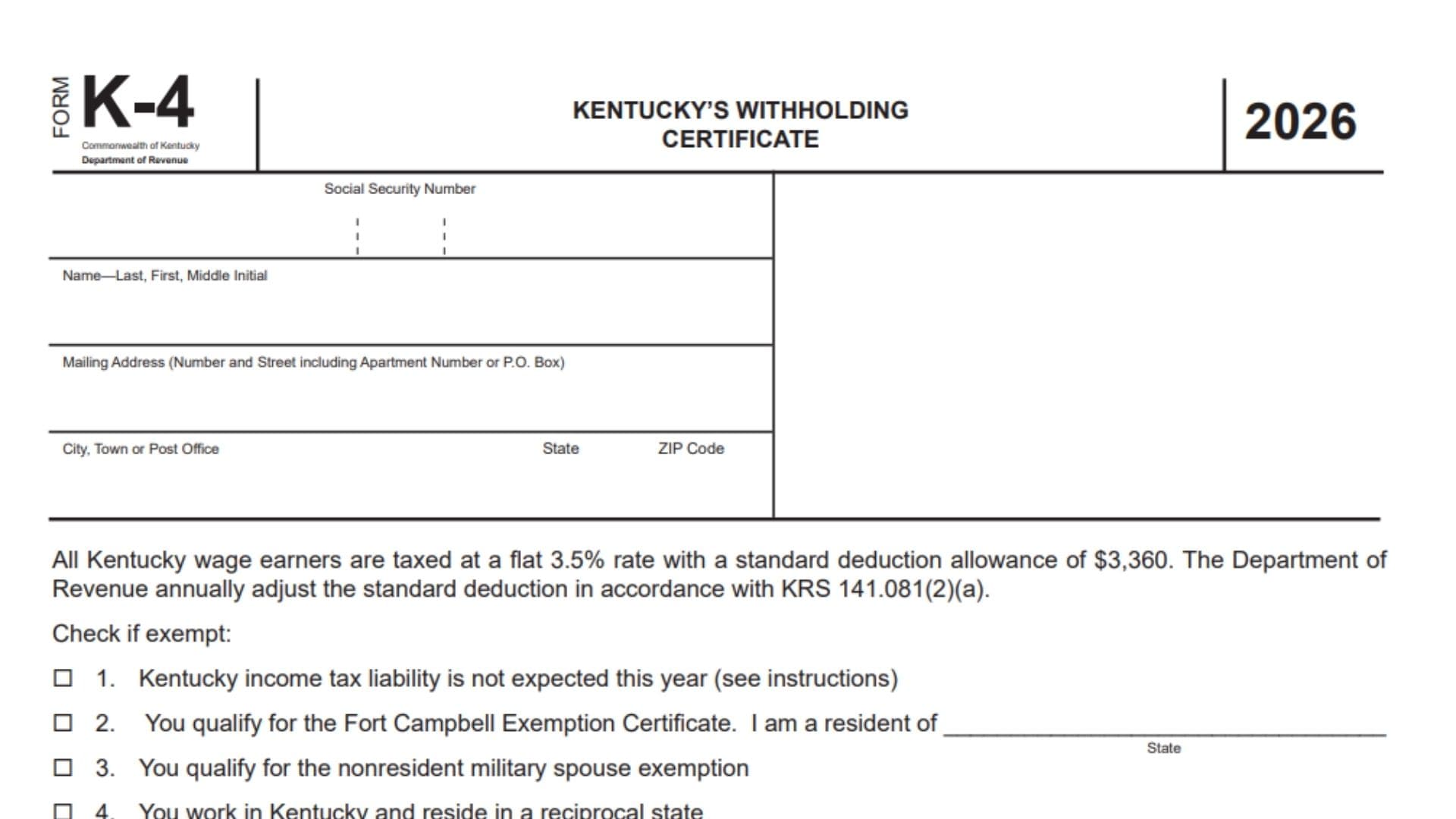
Kentucky Form K-4, Kentucky’s Withholding Certificate, is an employee withholding form used for specific Kentucky income tax withholding situations during 2026. It is primarily needed when an employee qualifies for one of Kentucky’s four withholding exemptions or wants an employer to withhold an additional dollar amount from each pay period. The form is not a general withholding allowance worksheet that every Kentucky employee must complete. For 2026, Kentucky wage earners are subject to a flat 3.5% withholding tax rate with a standard deduction allowance of $3,360. An employee may use Form K-4 to claim exemption because they expect no Kentucky income tax liability, qualify for the Fort Campbell exemption, qualify as a nonresident military spouse, or work in Kentucky while residing in a qualifying reciprocal state. The form contains additional eligibility rules for each exemption, including income thresholds for employees claiming no tax liability, residency requirements for Fort Campbell employees, a six-question military spouse worksheet, and special conditions for residents of Virginia and Ohio. Employees who qualify for an exemption must complete the form and give it to their employer before Kentucky withholding can be stopped. Employees should also retain a copy for their records. Employers use a properly completed K-4 as documentation authorizing them to stop Kentucky withholding for an employee who qualifies for an exemption or to withhold an additional amount requested by the employee. If an employee neither claims an exemption nor asks for additional withholding, the employer is not required to maintain a K-4 for that employee.
Who Needs To Complete Kentucky Form K-4?
You generally need to complete Form K-4 when one of two situations applies.
First, you are claiming one of the four Kentucky withholding exemptions listed on the form.
Second, you want your employer to deduct an additional amount of Kentucky income tax from each paycheck beyond the amount normally calculated under Kentucky withholding rules.
If neither situation applies, the employer instructions state that the employer does not need to maintain a K-4 for you.
How To File Kentucky Form K-4
Form K-4 is completed by the employee and provided to the employer.
Complete Your Personal Information
Start by entering your Social Security number, full name, mailing address, city or town, state, and ZIP Code.
Make sure the information is readable and accurate because it identifies the employee claiming the exemption or requesting additional withholding.
Determine Whether You Qualify For An Exemption
Review all four exemption categories before checking a box.
Do not select an exemption simply because you would prefer not to have Kentucky income tax withheld. You must satisfy the conditions associated with the exemption you claim.
Some exemptions also require completing a worksheet on the second part of the form.
Enter Additional Withholding If Requested
If you want extra Kentucky income tax withheld from each pay period under an arrangement with your employer, enter the additional dollar amount on the appropriate line.
Sign And Date The Certificate
Review the entire form before signing.
Your signature certifies, under penalties of perjury, that you have examined the certificate and believe the information you provided is true, correct, and complete.
Give The Form To Your Employer
Provide the completed K-4 to your employer.
An employee claiming an exemption must file the completed form with the employer before the employer is authorized to discontinue Kentucky income tax withholding.
Keep A Copy
Keep a copy of the completed K-4 with your permanent records.
The employer should also retain copies of K-4 forms received from employees.

How To Complete Kentucky Form K-4 Line By Line
The following instructions cover the form from the first identification field through the employee worksheets and employer instructions.
Employee Identification Information
Social Security Number
Enter your Social Security number in the space provided.
Check every digit carefully before submitting the form. This number identifies the employee to whom the withholding certificate applies.
Name — Last, First, Middle Initial
Enter your name in the order requested:
Last Name, First Name, Middle Initial
Use your legal name and make sure it corresponds with the identifying information your employer maintains for payroll and tax reporting.
If you do not use a middle initial, do not invent one.
Mailing Address
Enter your complete mailing address.
Include the street number and street name. If applicable, also include your apartment number.
If you receive mail at a P.O. box instead of a street address, enter the P.O. box information.
City, Town Or Post Office
Enter the city, town, or post office associated with your mailing address.
State
Enter the state associated with the mailing address you provided.
ZIP Code
Enter the correct ZIP Code for your mailing address.
Review the entire address before continuing.
2026 Kentucky Withholding Information
The form explains that Kentucky wage earners are taxed at a flat rate of 3.5% for 2026.
It also lists a standard deduction allowance of $3,360.
The standard deduction is adjusted periodically under Kentucky law, so the amount printed on this 2026 form applies to this version of the certificate.
There is no amount for you to enter on this informational line.
Check If Exempt
The form provides four exemption boxes.
Only check an exemption after confirming that you meet its requirements.
Box 1 — No Kentucky Income Tax Liability Expected
Check Box 1 only if you qualify for the exemption based on having no expected Kentucky income tax liability.
The detailed employee instructions require two conditions to be satisfied.
First Condition — 2025 Kentucky Tax Liability
For 2025, you must have been entitled to a refund of all Kentucky income tax withheld because you had no Kentucky income tax liability.
In other words, merely receiving some refund for 2025 does not satisfy this condition. The form bases the exemption on having no Kentucky income tax liability and being entitled to receive back all Kentucky income tax that was withheld.
Second Condition — Expected 2026 Kentucky Tax Liability
For 2026, you must expect to receive a refund of all Kentucky income tax withheld.
Both the prior-year and current-year conditions must apply before you check Box 1.
2025 Income Tax Liability Thresholds
The employee instructions provide expected 2025 filing-threshold amounts based on the federal poverty level.
These figures help employees evaluate whether they may have a Kentucky income tax liability.
Family Size Of One
The expected threshold is $15,650.
This category includes an individual who is single or a married individual who lived apart from their spouse for the entire year.
Family Size Of Two
The expected threshold is $21,150.
Examples listed by the form include a single individual with one dependent child or a married couple.
Family Size Of Three
The expected threshold is $26,650.
Examples include a single individual with two dependent children or a married couple with one dependent child.
Family Size Of Four Or More
The expected threshold is $32,150.
Examples include a single individual with three dependent children or a married couple with two or more dependent children.
Modified Gross Income For The Exemption Test
For purposes of these instructions, modified gross income begins with your federal adjusted gross income.
You then include applicable interest income from municipal bonds issued by other states and pension income from a qualifying lump-sum distribution.
If the combined modified gross income for you and your spouse, when applicable, is expected to fall below the threshold for your family size, you may not have a Kentucky income tax liability.
Remember that the form still requires both conditions described under Box 1 before you claim the exemption.
Box 1 Expiration Date
If you qualify and claim the Box 1 exemption for 2026, the form states that the exemption expires on February 15, 2027.
Do not assume the exemption continues indefinitely into future tax years.
Box 2 — Fort Campbell Exemption
Check Box 2 if you qualify for the Fort Campbell exemption.
This exemption concerns qualifying compensation earned as an employee at the Fort Campbell, Kentucky military base.
Kentucky Residency Requirement
To qualify under the form’s instructions, you must not be a resident of Kentucky.
The form explains that Kentucky residency can include an individual domiciled in Kentucky or an individual who is not domiciled in Kentucky but maintains a place of abode in Kentucky and spends more than 183 days of the taxable year in the state.
Employment Requirement
The Box 2 instructions apply when you are a nonresident of Kentucky and earn wages as an employee at Fort Campbell, Kentucky.
Check this exemption only when your circumstances satisfy the requirements described for Fort Campbell compensation.
State Of Residence
On the Box 2 line, the certificate includes a blank after the statement identifying you as a resident of another state.
Enter the state in which you are a resident.
The state entered should be a state other than Kentucky if you are claiming the Fort Campbell exemption under these instructions.
Moving Or Changing Your Address To Kentucky
If you claim this exemption and later move or change your address to Kentucky, the form requires the exemption to be revoked within 10 days.
Therefore, do not continue using the Fort Campbell exemption after a change that makes you ineligible.
Box 3 — Nonresident Military Spouse Exemption
Check Box 3 if you qualify for the nonresident military spouse exemption.
The form bases this exemption on conditions under the Servicemembers Civil Relief Act as amended by the Military Spouses Residency Relief Act.
You must complete the military spouse worksheet to determine whether you qualify.
Complete The Form In Full
To use the military spouse exemption, complete the K-4 fully rather than submitting only the worksheet.
You must certify that your circumstances satisfy the conditions that exempt you from Kentucky withholding.
Military Identification Requirement
The instructions require supporting military identification.
Provide a copy of your spouse’s military picture identification issued by the U.S. Department of Defense as required by the form.
When To Check Box 3
Do not check Box 3 merely because your spouse serves in the military.
You must answer YES to all six statements in the military spouse worksheet.
If any required answer is NO, the worksheet does not establish eligibility for the exemption.
Nonresident Military Spouse Worksheet
Complete every question in this worksheet by checking either YES or NO.
Question 1 — Spouse Is A Military Servicemember
The statement asks whether your spouse is a military servicemember.
Check YES if this is true.
To qualify through this worksheet, this answer must be YES.
Question 2 — You Are Not A Military Servicemember
The second statement asks you to certify that you are not a military servicemember.
Check YES only if you are not serving as a military servicemember yourself.
This answer must also be YES to qualify.
Question 3 — Spouse Has Current Military Orders In Kentucky
Indicate whether your military servicemember spouse currently has military orders assigning them to a military location in Kentucky.
Check YES if your spouse has such current orders.
A YES response is required for the exemption under this worksheet.
Question 4 — You And Your Spouse Live At The Same Address
Indicate whether you and your military servicemember spouse live at the same address.
Check YES only when this statement accurately describes your living arrangement.
This question must also be answered YES to satisfy the worksheet.
Question 5 — Spouse Has A State Of Domicile Other Than Kentucky
Indicate whether your military spouse’s state of domicile is somewhere other than Kentucky and whether you are choosing to use that same state of domicile.
Check YES only when both parts of the statement are true.
Two-Letter State Code
If you answer YES to Question 5, enter the two-letter abbreviation for your military spouse’s state of domicile in the space provided.
For example, use the standard two-letter state code rather than writing an unrelated location or military installation.
Question 6 — Presence In Kentucky Is Solely To Be With Your Military Spouse
Indicate whether you are present in Kentucky solely because you are accompanying your military servicemember spouse.
Check YES only if the statement accurately applies to you.
Result Of The Military Spouse Worksheet
If you checked YES to all six statements, the form states that your earned income is exempt from Kentucky income tax withholding.
You may then check Box 3 on the main portion of Form K-4.
When The Military Spouse Exemption Ends
The military spouse exemption does not necessarily continue permanently.
If an answer that allowed you to qualify changes from YES to NO, the exemption terminates.
The form explains that the termination date will generally be the earliest of several events.
Military Spouse Leaves Military Service
The exemption can end on the date your military servicemember spouse is no longer in military service.
Employee Enlists In The Military
The exemption can end if you, the employee claiming the military spouse exemption, enlist in the military.
Spouses Stop Living At The Same Address
The exemption can terminate if you and your military servicemember spouse no longer live at the same address.
Permanent Duty Station Moves Outside Kentucky
The exemption can also terminate when your military spouse’s permanent duty station changes to a location outside Kentucky.
If your circumstances change, reevaluate the exemption rather than continuing to rely on an earlier K-4.
Box 4 — Reciprocal State Exemption
Check Box 4 if you work in Kentucky but reside in a qualifying reciprocal state and meet the applicable conditions.
You must also complete the reciprocal-state section of the form.
Kentucky Nonresidency Statement
The worksheet asks you to certify that you have not been a Kentucky resident during the year.
Only proceed with the reciprocal-state exemption when that statement is accurate.
Illinois
Check Illinois if you reside in Illinois and work in Kentucky.
Indiana
Check Indiana if you reside in Indiana and work in Kentucky.
Michigan
Check Michigan if you reside in Michigan and work in Kentucky.
West Virginia
Check West Virginia if you reside in West Virginia and work in Kentucky.
Wisconsin
Check Wisconsin if you reside in Wisconsin and work in Kentucky.
Virginia
Check Virginia if you reside in Virginia and commute daily to your place of employment in Kentucky.
The form specifically states that daily commuting is required for the Virginia exemption to apply.
Do not select the Virginia option if you do not satisfy the daily commuting condition.
Ohio
Check Ohio if you live in Ohio and work in Kentucky, provided that you are not a shareholder-employee who owns, directly or indirectly, an equity interest of 20% or more in an S corporation.
If you meet or exceed that ownership threshold in the circumstances described by the form, do not use this Ohio reciprocal-state option without determining whether you qualify.
Completing Box 4
After confirming that you satisfy the applicable reciprocal-state condition, check Box 4 on the main portion of the K-4.
The exemption is based on working in Kentucky while residing in the qualifying reciprocal state.
Additional Withholding Per Pay Period
The form includes a separate line for requesting additional Kentucky income tax withholding.
Use this line if you and your employer agree that an additional dollar amount should be withheld from every pay period.
Dollar Amount
Enter the additional amount you want withheld from each paycheck.
For example, if you want an extra fixed dollar amount withheld each pay period, enter that amount on this line.
This is an additional withholding amount, not the total amount of Kentucky withholding you expect for the pay period.
Make sure you understand how frequently you are paid because the amount applies on a per-pay-period basis.
Employee Declaration
Immediately above the signature area, the form contains a declaration made under penalties of perjury.
By signing, you are confirming that you reviewed the certificate and that, to the best of your knowledge and belief, the information is true, correct, and complete.
Do not sign the form before checking the exemption box, worksheet responses, additional withholding amount, and personal information for accuracy.
Signature
Sign your name on the signature line.
The employee claiming the exemption or requesting additional withholding should provide the signature.
Your signature completes the certification required by the form.
Date
Enter the date on which you sign the K-4.
Make sure the date is complete and readable.
What To Do After Completing Form K-4
If you qualify for one of the four exemptions, you must give the completed K-4 to your employer before Kentucky withholding can be stopped.
Your employer may discontinue Kentucky withholding once a properly completed K-4 documents that you qualify for the exemption.
Keep a copy of the form for your permanent records.
If circumstances affecting your exemption change, review the applicable rules again rather than assuming the existing certificate remains valid.
Instructions To Employers
The final section of Form K-4 provides instructions specifically for employers receiving the certificate from employees.
When An Employer Needs Form K-4
An employer needs Form K-4 to document either of the following:
- An employee has requested exemption from Kentucky withholding.
- An employee has requested additional withholding above the amount produced by the normal Kentucky withholding formula or tables.
If neither situation applies, the form states that an employer is not required to maintain a K-4 for the employee.
When An Employer May Stop Kentucky Withholding
Once the employer receives a properly completed K-4 from an employee who qualifies for one of the four exemptions, the employer is authorized to discontinue Kentucky income tax withholding for that employee.
The employer should make sure the form has been properly completed before relying on it to stop withholding.
Employer Recordkeeping Requirement
Employers should retain a copy of every K-4 received from employees.
The form serves as documentation supporting the employee’s exemption request or request for additional withholding.
Final Review Before Giving Form K-4 To Your Employer
Before submitting your 2026 Kentucky K-4, confirm that your Social Security number, name, mailing address, city or town, state, and ZIP Code are correct. If you are claiming an exemption, make sure you checked the appropriate exemption box and actually meet all of its requirements. For Box 1, confirm that both the prior-year and expected current-year tax-liability conditions apply. For the Fort Campbell exemption, enter your non-Kentucky state of residence and make sure the residency and employment requirements are satisfied. For the military spouse exemption, complete all six worksheet questions, confirm that every required response is YES, enter the two-letter domicile state code, and provide the required military identification documentation. For the reciprocal-state exemption, check the state where you reside and confirm any special Virginia or Ohio requirements. If you are requesting extra withholding, enter the additional dollar amount to be deducted each pay period. Finally, read the declaration, sign and date the certificate, provide the completed form to your employer, and keep a copy for your records.