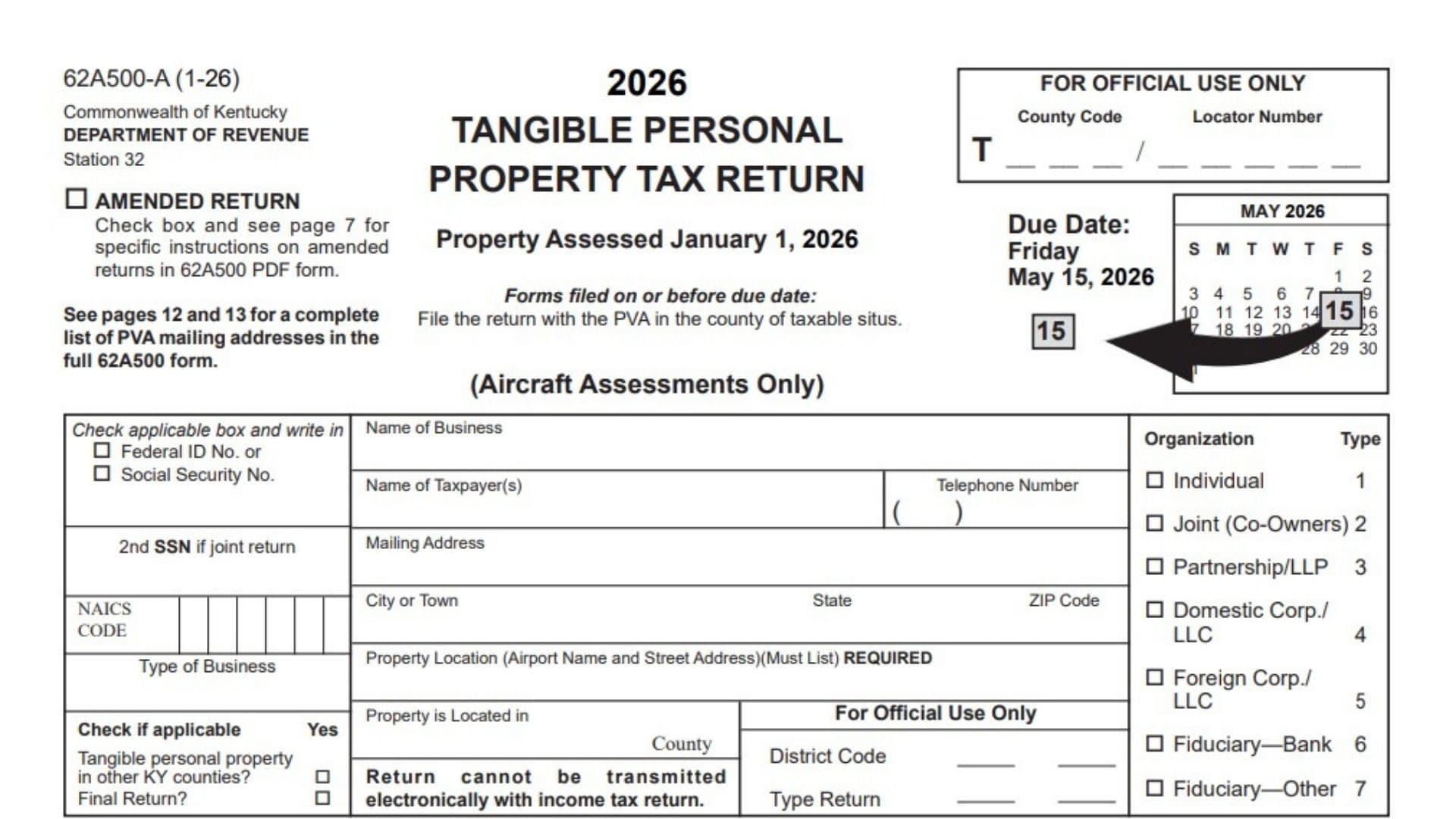
Kentucky Form 62A500-A is a tangible personal property tax return used specifically to report aircraft that were owned on January 1, 2026, and subject to property assessment in Kentucky. The return collects information about the aircraft owner, business structure, property location, federal registration details, serial number, aircraft specifications, estimated value, and general condition. It allows the Kentucky Department of Revenue, the Office of Property Valuation, and the appropriate county Property Valuation Administrator, commonly called the PVA, to determine where the aircraft has taxable situs and how it should be assessed for property tax purposes. The return applies to qualifying aircraft regardless of whether the owner lives in Kentucky, provided the aircraft is taxable within the state. Each reportable aircraft must be identified with enough detail to distinguish it from other aircraft, including its year, manufacturer, model, size, power, registration number, and serial number. Owners may also provide supporting details about avionics, engine hours, physical condition, or other factors that could influence market value. Aircraft assessed as public service company property should not be entered, and aircraft operated for hire must not be reported on this particular return. The assessment date is January 1, 2026, meaning the information should reflect ownership, condition, location, and value as they existed on that date rather than on the date the return is completed.
Who Should File This Return?
You may need to complete this return when you owned an aircraft on January 1, 2026, and that aircraft had a taxable location in Kentucky.
The filing requirement may apply to:
- Individual aircraft owners
- Joint owners
- Partnerships and limited liability partnerships
- Domestic corporations or limited liability companies
- Foreign corporations or limited liability companies
- Bank fiduciaries
- Other fiduciaries
- Businesses that own aircraft for their own use
Do not use the return to report an aircraft for hire. Also exclude aircraft already assessed as property belonging to a public service company.
When Is The Return Due?
The 2026 filing deadline is Friday, May 15, 2026.
The small May 2026 calendar printed near the top of the return highlights May 15 as the due date. The calendar is provided only as a visual reminder and does not require an entry.
Kentucky does not provide an extension for filing this tangible personal property tax return. Prepare and submit it early enough to ensure that it reaches the correct office by the deadline.
How To File Form 62A500-A
Determine The Aircraft’s Taxable Situs
Taxable situs generally means the Kentucky county where the aircraft is considered located for property tax purposes. Enter the actual airport and street address where the aircraft is based or kept.
Do not automatically use the owner’s home address, business mailing address, or state of residence unless that location is also the aircraft’s taxable location.
Select The Correct Filing Office
Submit the completed return to the Property Valuation Administrator in the Kentucky county where the aircraft has taxable situs. The return may also be submitted to the Office of Property Valuation when appropriate.
The complete Form 62A500 instructions contain the mailing addresses for Kentucky PVA offices. Use the address for the county entered in the property-location section.
Do Not Attach It To An Income Tax Return
This property tax return cannot be transmitted electronically with a Kentucky income tax return. It must be filed separately through the applicable property valuation filing process.
Include Supporting Sheets When Necessary
The table provides space for several aircraft entries. If you need to report additional aircraft or provide more information than the available space permits, attach a separate sheet.
Each attachment should include:
- The taxpayer’s name
- The business name, when applicable
- The aircraft registration number
- The aircraft serial number
- The corresponding line number
- All other information requested in the aircraft table
Keep A Copy
Retain a completed copy of the return and all supporting records. Useful records may include registration documents, purchase records, aircraft appraisals, maintenance logs, engine-hour reports, equipment lists, and evidence supporting the reported value.

How To Complete Form 62A500-A
Header And Filing Status
Form Number And Revision
The number shown in the upper-left corner identifies the aircraft return and its January 2026 revision. This is printed information, so the taxpayer does not need to enter anything here.
Department And Station Information
The Kentucky Department of Revenue and Station 32 information identifies the agency and internal processing location associated with the return. Do not write over or alter this printed area.
Tax Year
The year shown at the top is 2026. Complete the return using ownership and valuation information applicable to the 2026 assessment year.
Tangible Personal Property Tax Return
The main heading identifies the document as a tangible personal property tax return. The aircraft designation below the heading limits this particular return to qualifying aircraft assessments.
Property Assessed January 1, 2026
Report the aircraft owned as of January 1, 2026. Use the aircraft’s condition, configuration, taxable location, and ownership status on that date.
An aircraft purchased after January 1 generally would not be included as property owned on the assessment date. An aircraft sold after January 1 may still need to be reported by the person or organization that owned it on January 1.
Amended Return
Check the amended-return box only when correcting or replacing information from a return that was previously filed for the same assessment year.
An amended filing may be necessary when the original return contained:
- An incorrect aircraft value
- An incorrect registration or serial number
- A missing aircraft
- An aircraft that should not have been reported
- An incorrect ownership structure
- An incorrect property location
- Other material errors
Follow the amended-return instructions included with the complete Form 62A500 filing materials. Clearly identify the information being changed and include supporting explanations when helpful.
PVA Mailing Address Notice
The return directs taxpayers to the full Form 62A500 instructions for the complete list of PVA mailing addresses. Use the address for the county where the aircraft has taxable situs.
Filing Destination Notice
When filing by the due date, send the return to the PVA for the county of taxable situs. This instruction confirms that the aircraft’s taxable location, not necessarily the owner’s mailing address, determines the county filing office.
Due Date
The deadline shown is Friday, May 15, 2026. Submit the completed return on or before this date.
Official Use Only Areas
County Code And Locator Number
The box in the upper-right corner contains spaces for a county code and locator number. These fields are reserved for government processing.
Do not enter information in the box marked for official use.
T Reference Field
The printed letter “T” and the blank number spaces beside it form part of the official processing area. Leave these spaces blank unless an authorized official specifically instructs you otherwise.
Taxpayer Identification Information
Federal Identification Number Or Social Security Number
Check the box that identifies the type of taxpayer identification number being provided.
Choose one of the following:
- Federal identification number, generally used by a business or other entity
- Social Security number, generally used by an individual taxpayer
After checking the correct box, enter the corresponding identification number in the space provided. Use the number associated with the legal owner of the aircraft.
Second Social Security Number
Complete this field when the return is being filed jointly and there is a second owner whose Social Security number must be reported.
Leave it blank when:
- There is only one individual owner
- The owner is a business using a federal identification number
- A second Social Security number does not apply
NAICS Code
Enter the North American Industry Classification System code that best describes the taxpayer’s primary business activity.
The code should reflect the main business operation of the owner rather than simply describing the aircraft. For example, a construction company that owns an aircraft would generally use the code for its construction activity.
An individual who does not operate a business should follow the applicable state instructions or ask the PVA whether a code is required.
Type Of Business
Write a brief description of the taxpayer’s principal business activity.
Examples may include:
- Real estate development
- Manufacturing
- Agricultural operations
- Medical services
- Corporate consulting
- Aircraft management
Keep the description accurate and consistent with the NAICS code.
Additional Filing Questions
Tangible Personal Property In Other Kentucky Counties
Check “Yes” if the taxpayer owns taxable tangible personal property in Kentucky counties other than the county covered by this return.
This question applies to tangible personal property generally, not only to the aircraft being listed on this page.
Leave the box unmarked or follow the applicable “No” procedure when there is no taxable personal property in another Kentucky county.
Owning property in multiple counties may require separate returns because each county assesses property located within its jurisdiction.
Final Return
Check the final-return box when this is the taxpayer’s last expected return for the account or taxable activity.
A final return may be appropriate when:
- The business has permanently closed
- The business has left Kentucky
- All reportable aircraft have been sold
- The taxpayer no longer owns taxable property in the county
- The legal entity has been dissolved
- The account should be closed for future filing purposes
Do not mark the return as final merely because no aircraft will be added during the current year.
Owner And Business Information
Name Of Business
Enter the full legal name of the business that owns the aircraft.
Use the name appearing on the entity’s registration, tax records, and aircraft ownership documents. Avoid shortened trade names unless the trade name is the owner’s legal name.
An individual who does not operate through a business entity may enter the applicable ownership name or follow the PVA’s instructions.
Name Of Taxpayer Or Taxpayers
Enter the legal name of the individual, joint owners, business entity, fiduciary, or other taxpayer responsible for filing the return.
For joint ownership, list each applicable taxpayer. The ownership information should agree with the aircraft’s Federal Aviation Administration registration.
Telephone Number
Provide a current telephone number where the taxpayer or an authorized representative can be reached.
Include the area code. Use a number that will remain active during the assessment review period in case the PVA needs clarification.
Mailing Address
Enter the address where tax correspondence, assessment notices, and other communications should be sent.
The mailing address may differ from the aircraft’s physical location.
City Or Town
Enter the city or town associated with the mailing address.
State
Provide the two-letter state abbreviation for the mailing address.
ZIP Code
Enter the complete ZIP Code. Include the four-digit extension when it is known and regularly used.
Aircraft Location Information
Property Location
Enter the airport name and the complete street address where the aircraft is based, stored, or otherwise physically located for assessment purposes.
This field is required. Do not provide only the airport identifier when a street address is available.
A complete entry may include:
- Airport name
- Hangar or facility name
- Hangar number
- Street number
- Street name
- City
- ZIP Code
The property location should describe the aircraft’s actual taxable location, not merely the taxpayer’s mailing address.
County
Enter the Kentucky county in which the aircraft is located for property tax purposes.
This county determines the PVA office that generally receives and processes the return.
District Code
The district-code area is reserved for official use. Do not complete it.
Type Return
The type-return boxes are also for official processing. Leave them blank unless the assessing office directs you to enter information.
Organization Type
Check one box that matches the legal structure of the aircraft owner. Do not select more than one unless instructed by the PVA.
Individual, Type 1
Select Individual when one person owns the aircraft in their own name and the ownership is not held through a separate business entity.
Joint Co-Owners, Type 2
Select Joint when two or more people own the aircraft together as co-owners.
Make sure all relevant owners are identified in the taxpayer-name area.
Partnership Or LLP, Type 3
Select this option when the aircraft is owned by a partnership or limited liability partnership.
Use the partnership’s legal name and federal identification number.
Domestic Corporation Or LLC, Type 4
Select this option when the aircraft is owned by a corporation or limited liability company formed under Kentucky law.
Foreign Corporation Or LLC, Type 5
Select this option when the owner is a corporation or limited liability company organized under the laws of another state or jurisdiction but has reportable property in Kentucky.
“Foreign” in this context generally refers to an entity formed outside Kentucky. It does not necessarily mean that the company was formed outside the United States.
Fiduciary, Bank, Type 6
Select this option when a bank is acting in a fiduciary capacity as the aircraft owner or reporting taxpayer.
Fiduciary, Other, Type 7
Select this option when a trustee, estate representative, guardian, or another non-bank fiduciary is responsible for the property.
Aircraft Reporting Requirements
Before entering information in the table, identify every reportable aircraft owned on January 1, 2026.
For each aircraft, gather:
- Federal registration number
- Manufacturer’s serial number
- Year
- Manufacturer or make
- Model
- Aircraft size
- Power or engine information
- Estimated value
- General condition
Additional Sheets
Attach a separate schedule when the provided rows are insufficient. Use the same column order as the original table so each aircraft can be reviewed easily.
Public Service Company Aircraft
Do not list an aircraft already assessed as public service company property. Confirm the assessment treatment before excluding it when the ownership or use arrangement is unclear.
Avionics And Equipment
Provide information about installed avionics or optional equipment when those items could affect the aircraft’s value.
Relevant equipment may include:
- Navigation systems
- Communication equipment
- Weather radar
- Autopilot systems
- Upgraded instrument panels
- Supplemental fuel systems
- Safety equipment
- Other significant modifications
Aircraft Condition
Describe the aircraft’s actual condition as of January 1, 2026. Consider maintenance history, airworthiness, physical appearance, damage, storage conditions, and operational status.
Engine Hours
Include engine-hour information when it could influence value. When applicable, identify total time, time since overhaul, or other meaningful engine-status information.
Supporting Documentation
Attach records that help explain a reported value, unusual condition, major damage, extensive upgrades, or another factor that materially affects the aircraft.
FAA Registration Consistency
Enter the owner’s information as it appears on the Federal Aviation Administration registration. Differences in spelling, entity name, or ownership can delay processing or create questions about the correct taxpayer.
Residency Of The Owner
The filing requirement is based on the aircraft’s taxable situs. The owner may still be required to file even when residing or maintaining a principal business address outside Kentucky.
Aircraft For Hire
Do not report aircraft for hire on this return. If an aircraft is used in charter, commercial transportation, or another for-hire activity, determine the correct reporting procedure before filing.
Line 40 Aircraft Schedule Instructions
The table contains multiple rows marked Line 40. Use one complete row for each reportable aircraft.
Line Number
The number 40 is already printed in each row. It identifies the aircraft property category.
Do not replace the printed line number with an aircraft number or registration number.
Federal Registration Number And Serial Number
Enter both identifying numbers for the aircraft.
The federal registration number is commonly the registration displayed on the aircraft and listed in FAA records. The serial number is the unique manufacturer-assigned number.
Clearly distinguish between the two numbers. If space is limited, place each number on a separate line within the same box.
Description
Enter the aircraft’s year, make, model, size, and power information.
A clear description may include:
- Model year
- Manufacturer
- Model designation
- Number of seats
- Aircraft category
- Engine type
- Number of engines
- Horsepower or thrust
- Other identifying specifications
Do not use a vague description such as “airplane” or “business aircraft.” Provide enough detail for the assessor to identify and evaluate the aircraft.
Taxpayer’s Value
Enter the value you believe accurately represents the aircraft as of January 1, 2026.
The amount should reflect the aircraft’s specifications, age, equipment, operating status, engine hours, maintenance history, and condition.
Keep records showing how the value was determined. A valuation may be supported by an appraisal, recognized aircraft pricing information, comparable sales, purchase records, or other reliable market evidence.
Statement Of General Condition
Briefly explain the aircraft’s physical and operating condition.
Possible descriptions include:
- Excellent condition and fully operational
- Good condition with normal wear
- Average condition for age
- In storage and not currently operational
- Undergoing major maintenance
- Damaged and awaiting repair
- Engine overhaul required
- Airframe complete but avionics outdated
Add a supporting sheet when the condition cannot be explained adequately in the available space.
Official Use Only
The last column is reserved for the assessing authority. Do not write in it.
Additional Line 40 Rows
Repeat the same process for every additional aircraft. Each aircraft must have its own registration and serial number, description, value, and condition statement.
Do not combine several aircraft into one row, even when they are the same make and model.
Taxpayer Declaration
The declaration confirms, under penalties of perjury, that the return and all attached schedules are accurate and complete and that all taxable property required on the return has been reported.
Review the entire return before signing. Confirm that:
- Every reportable aircraft has been included
- Registration and serial numbers are correct
- Ownership information agrees with registration records
- The property location is complete
- Values reflect the January 1 assessment date
- Attachments are included
- Excluded aircraft are properly excluded
- No aircraft for hire is listed
Signing an incomplete or knowingly inaccurate return may carry legal consequences.
Signature And Contact Information
Signature Of Taxpayer
The taxpayer or an authorized person should sign the return.
For an entity, the signer should have authority to make the filing on the entity’s behalf.
Taxpayer Signature Date
Enter the date on which the taxpayer signs the return.
Name Of Preparer Other Than Taxpayer
When someone other than the taxpayer prepared the return, print that person’s name in this field.
A paid preparer, accountant, attorney, employee, or other representative may be listed here.
Leave the field blank when the taxpayer prepared the return without assistance from another preparer.
Preparer Date
Enter the date on which the preparer completed or signed the return.
Taxpayer Telephone Number
Provide the taxpayer’s current telephone number. The telephone symbol printed beside the contact row is simply a visual label and does not require a separate entry.
Taxpayer Email Address
Enter an email address that the assessing office may use to contact the taxpayer about the return.
Check the spelling carefully, especially in the domain portion of the address.
Preparer Telephone Number
Provide the preparer’s current telephone number when a preparer is identified.
Preparer Email Address
Enter the preparer’s email address so questions may be directed to the person who completed the return.
Final Filing Checklist
Before submitting the return, verify that you have:
- Used information effective January 1, 2026
- Checked the amended-return box only when appropriate
- Selected either a federal identification number or Social Security number
- Added the second Social Security number for a joint filing when required
- Entered the NAICS code and business type
- Answered the other-county property question
- Marked the final-return box only when the filing account should close
- Entered the legal business and taxpayer names
- Provided a telephone number and complete mailing address
- Listed the airport name and required street address
- Identified the Kentucky county of taxable situs
- Selected the correct organization type
- Reported every qualifying aircraft separately
- Included each registration number and serial number
- Described each aircraft’s year, make, model, size, and power
- Entered a supportable January 1 value
- Described each aircraft’s general condition
- Attached additional schedules when necessary
- Included relevant avionics and engine-hour information
- Excluded public service company aircraft
- Excluded aircraft for hire
- Left all official-use fields blank
- Signed and dated the declaration
- Completed the taxpayer and preparer contact fields
- Selected the correct PVA filing office
- Prepared the return for filing by May 15, 2026
Submit the return separately from the income tax filing and retain a complete copy with your supporting valuation and ownership records.