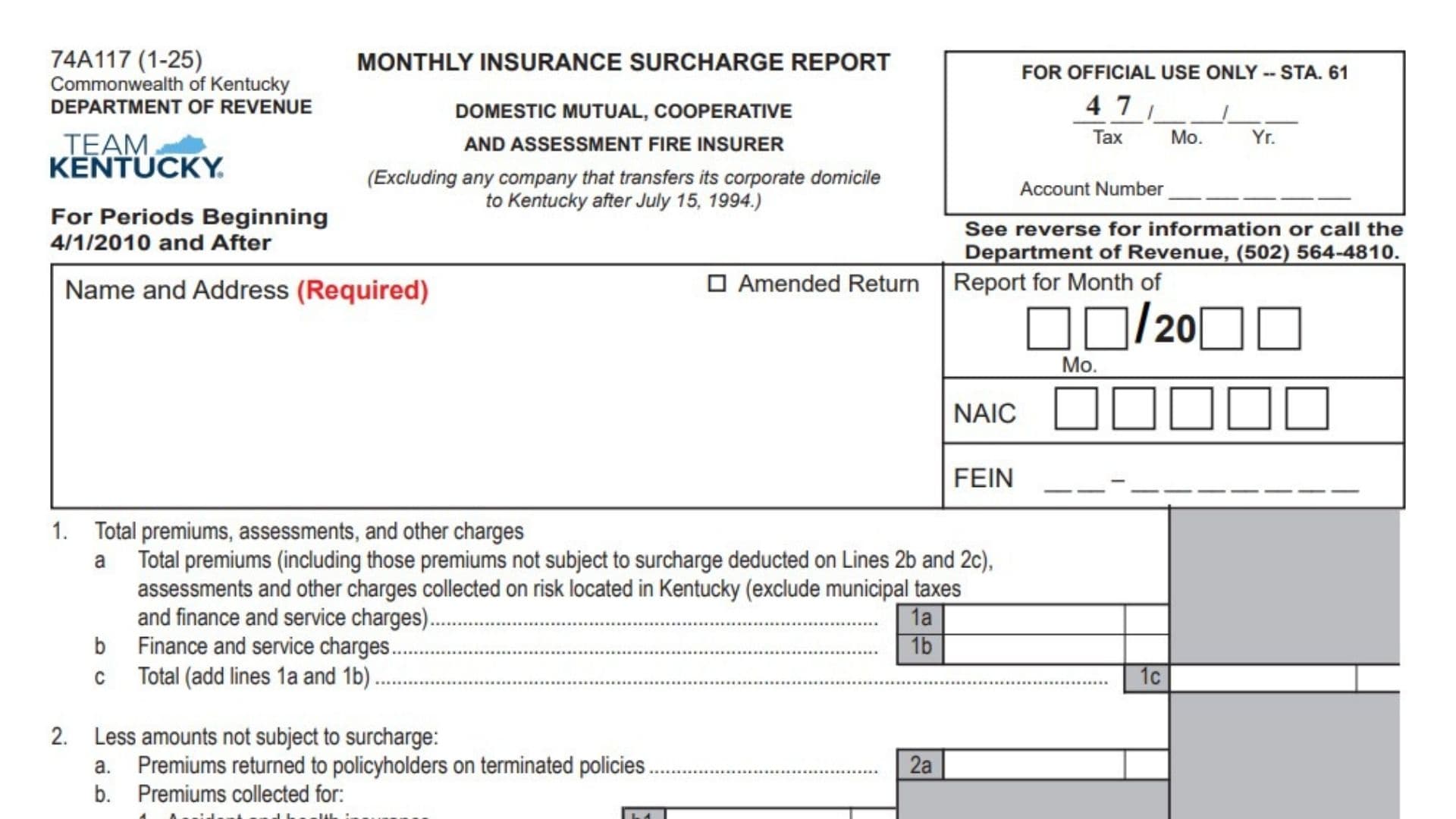
Kentucky Form 74A117 is the Monthly Insurance Surcharge Report used by qualifying domestic mutual, cooperative, and assessment fire insurers to report insurance premiums, assessments, finance charges, service charges, and other insurance-related amounts collected on risks located in Kentucky. The report calculates the portion of those collections that is subject to Kentucky’s insurance premium surcharge after permitted deductions and exemptions are applied. These deductions may include premiums returned on terminated policies, premiums for specified exempt insurance products, and qualifying premiums collected from governmental or nonprofit policyholders. The insurer reports the total collected amount, subtracts all eligible exclusions, multiplies the remaining taxable amount by 0.018, and then adds any applicable penalty, interest, or documented adjustment. The report must generally be filed for every monthly reporting period, including months in which no premiums were collected. It also requires the filing company’s name, address, NAIC number, FEIN, reporting month, payment information, principal officer certification, and preparer details. This form excludes a company that transferred its corporate domicile to Kentucky after July 15, 1994.
Who Must File The Monthly Insurance Surcharge Report?
The insurance premium surcharge generally applies to domestic, foreign, and alien insurers other than life and health insurers that are subject to, or exempt from, Kentucky insurance premium taxes under the applicable Kentucky insurance tax laws.
This particular report is identified for:
- Domestic mutual fire insurers
- Cooperative fire insurers
- Assessment fire insurers
It does not cover a company that transferred its corporate domicile to Kentucky after July 15, 1994.
Filing Is Required Even When No Premiums Were Collected
An insurer must file a report for each assigned reporting period, even when it collected no premiums during the month.
When no premiums were collected:
- Complete the company identification section.
- Enter the reporting month and year.
- Enter zero in the applicable financial lines.
- Complete the certification and preparer sections.
- Submit the report by the deadline.
Do not assume that a zero balance removes the filing requirement.
When Is Form 74A117 Due?
The monthly report and payment are due on or before the twentieth day of the month following the reporting period.
For example, a report covering premiums collected during June is due by July 20.
The report covers surcharge money collected during the preceding monthly accounting period, reduced by qualifying amounts returned to policyholders on terminated policies.
Annual Filing Exception
An insurer whose annual surcharge liability was less than $1,000 in each of the previous two calendar years may qualify to report and pay annually.
A qualifying annual filer submits its calendar-year surcharge collections by January 20 of the following year.
The monthly form should not be used as an annual report unless the Department of Revenue directs the company to do so.
How The Insurance Premium Surcharge Works
The insurer collects the surcharge from its policyholders at the same time and in the same manner that it collects the related insurance premium, assessment, or other charge.
The surcharge applies regardless of whether the underlying charge is described as:
- A premium
- An assessment
- A membership-related charge
- Another insurance charge
The insurer or its agent may not retain any part of the surcharge as a collection fee or commission.
When an insurer deducts a premium returned on a terminated policy, it must also have returned the related surcharge to the policyholder.
What To Gather Before Completing The Report
Collect the following records before starting:
- The company’s legal name and mailing address
- The monthly reporting period
- The company’s NAIC number
- The company’s FEIN
- Premiums actually collected on Kentucky risks
- Assessments and other insurance charges collected
- Finance and service charges
- Premiums returned on terminated policies
- Exempt insurance premium records
- Governmental and nonprofit policyholder records
- Penalty and interest calculations, when applicable
- Supporting documents for adjustments
- Online payment confirmation information
- Principal officer contact information
- Return preparer contact information
Report amounts that were actually collected during the month. Do not report premiums that were only billed but not received.

How to Complete Kentucky Form 74A117
How To Complete The Header Information
Form Number And Revision Date
The printed form number and revision date identify the version of the report.
No entry is required in this area.
Commonwealth And Department Information
The printed Commonwealth of Kentucky and Department of Revenue labels identify the government agency receiving the report.
Do not enter anything in this area.
Monthly Insurance Surcharge Report Title
The title identifies the return as a monthly insurance surcharge filing.
No entry is required beside the title.
Domestic Mutual, Cooperative, And Assessment Fire Insurer
This subtitle identifies the type of insurer for which the report is intended.
Confirm that the filing company falls within the stated insurer category before completing the report.
Corporate Domicile Exclusion
The report excludes a company that transferred its corporate domicile to Kentucky after July 15, 1994.
Review the company’s organizational history before using the form when its domicile changed.
Periods Beginning April 1, 2010, And After
The printed note indicates that the form applies to reporting periods beginning April 1, 2010, and later.
No entry is required beside this statement.
How To Complete The Official-Use Section
For Official Use Only
Leave the entire official-use box blank.
Do not write in the fields for:
- Station number
- Tax
- Month
- Year
- Account number
These fields are reserved for processing by the Kentucky Department of Revenue.
Do not alter the printed code or official-use information.
How To Complete The Company Identification Section
Name And Address
Enter the complete legal name and mailing address of the filing company.
This field is required.
Include:
- Legal company name
- Street number and street name
- Suite, floor, or unit number when applicable
- City
- State
- ZIP Code
Use the same legal name connected to the company’s FEIN, NAIC number, and Kentucky tax account.
Amended Return
Check the “Amended Return” box only when correcting a report that was previously filed for the same monthly period.
Leave the box blank when filing the original report.
When filing an amended return, enter the corrected complete amounts throughout the report. Do not enter only the difference between the original figures and the corrected figures.
Attach an explanation or supporting documents when needed to show why the report is being amended.
Report For Month Of
Enter the month covered by the report.
Use the two-digit month format shown in the boxes.
Examples include:
- 01 for January
- 04 for April
- 09 for September
- 12 for December
Enter the applicable year after the printed “20.”
For example, a report for June 2025 would show:
06/2025
Do not enter the month in which the report is being prepared unless that is also the month being reported.
NAIC
Enter the company’s National Association of Insurance Commissioners identification number.
Use the five boxes provided and place one digit in each box.
Verify that the NAIC number belongs to the same legal company named on the report.
FEIN
Enter the company’s nine-digit Federal Employer Identification Number.
Use the FEIN assigned to the filing legal entity.
Enter the first two digits before the hyphen and the remaining seven digits after it.
Do not use an owner’s Social Security number in place of the company’s FEIN.
How To Complete Line 1: Total Premiums, Assessments, And Other Charges
Line 1 reports the company’s total monthly collections before exempt and returned amounts are deducted.
Line 1a: Total Premiums And Other Insurance Charges
Enter all premiums, assessments, and other insurance charges actually collected during the reporting month on risks located in Kentucky.
Include premiums that are not subject to the surcharge when those amounts will later be deducted on Lines 2b or 2c.
Include the applicable collected amounts for:
- Taxable insurance premiums
- Exempt insurance premiums later deducted on Line 2
- Assessments
- Other charges collected for insurance on Kentucky risks
Do not include municipal taxes on Line 1a.
Do not include finance and service charges on Line 1a. Those charges must be reported separately on Line 1b.
Enter only collected premiums. Do not include unpaid billings, outstanding receivables, or amounts expected to be collected later.
Line 1b: Finance And Service Charges
Enter finance charges and service charges collected during the reporting month.
Report these charges separately from the premiums and assessments entered on Line 1a.
Do not leave this line blank when the company collected qualifying finance or service charges.
Line 1c: Total Collections
Add Line 1a and Line 1b.
The calculation is:
Line 1a + Line 1b = Line 1c
Enter the combined amount on Line 1c.
This amount represents the company’s total reported collections before subtracting returned premiums and exempt amounts.
How To Complete Line 2: Amounts Not Subject To Surcharge
Line 2 removes premiums and other amounts that are not subject to the insurance premium surcharge.
Do not deduct the same amount in more than one category.
Line 2a: Premiums Returned On Terminated Policies
Enter premiums returned to policyholders because the related insurance policies were terminated.
A policy may have been terminated by either:
- The policyholder
- The insurer
Use Line 2a only when:
- The premium was actually returned to the policyholder.
- The related insurance premium surcharge was also returned to the policyholder.
- The policy was terminated.
Do not use this line for premiums that were exempt from the surcharge but were not returned.
For example, workers’ compensation premiums belong on Line 2b6, not Line 2a.
Refund requests must be made in writing.
Keep records showing the terminated policy, returned premium, returned surcharge, and date of repayment.
How To Complete Line 2b: Exempt Types Of Insurance
Lines 2b1 through 2b6 report premiums collected for specified types of insurance that are not subject to the surcharge.
These premiums should generally be included in Line 1a before being deducted here.
Line 2b1: Accident And Health Insurance
Enter premiums collected for accident and health insurance.
Do not include unrelated property, casualty, fire, or other insurance premiums on this line.
Line 2b2: Federally Insured Crop Insurance
Enter premiums collected for crop insurance that is federally insured.
Do not enter crop insurance premiums that do not meet the federal insurance requirement.
Line 2b3: Federally Insured Flood Insurance
Enter premiums collected for federally insured flood insurance.
Keep these premiums separate from other property or flood-related coverage that does not qualify for the exemption.
Line 2b4: Reinsurance
Enter premiums received for reinsurance.
Do not report direct insurance premiums issued to individual or business policyholders as reinsurance.
Line 2b5: Title Insurance
Enter premiums collected for title insurance.
Report only amounts connected with qualifying title insurance coverage.
Line 2b6: Workers’ Compensation Insurance
Enter premiums collected for workers’ compensation insurance.
Do not report workers’ compensation premiums as returned premiums on Line 2a unless they were actually returned on terminated policies and otherwise meet the requirements for that line.
Line 2b: Total Exempt Insurance Premiums
Add Lines 2b1 through 2b6.
The calculation is:
Line 2b1 + Line 2b2 + Line 2b3 + Line 2b4 + Line 2b5 + Line 2b6 = Line 2b
Enter the combined total on Line 2b.
Review the calculation to ensure that no premium was entered in more than one exempt insurance category.
How To Complete Line 2c: Premiums From Exempt Policyholders
Lines 2c1 through 2c4 report premiums collected from governmental and qualifying nonprofit policyholders.
The exemption may depend on both the policyholder’s status and the type of property or coverage insured.
Line 2c1: Federal Government
Enter qualifying premiums collected directly from the federal government.
Do not enter premiums from a private contractor merely because the contractor performs work for the federal government.
The policyholder’s identity determines whether this exemption applies.
Line 2c2: Resident Nonprofit Educational And Charitable Institutions
Enter qualifying premiums collected from resident educational or charitable institutions that have Section 501(c)(3) status.
Confirm that the institution:
- Is a resident institution
- Is organized for educational or charitable purposes
- Qualifies under Section 501(c)(3)
Do not enter premiums collected from a for-profit organization or an entity without the required nonprofit status.
Line 2c3: Resident Nonprofit Religious Institutions
Enter qualifying premiums collected from resident nonprofit religious institutions.
The exemption applies only to coverage of:
- Real property
- Tangible property
- Intangible property
Do not include premiums for coverage outside these property categories.
Line 2c4: State And Local Government
Enter qualifying premiums collected from state and local governmental entities for real property coverage.
The exemption is limited to the qualifying real property coverage.
Do not automatically treat every insurance policy purchased by a state or local government as exempt.
Line 2c: Total Premiums From Exempt Policyholders
Add Lines 2c1 through 2c4.
The calculation is:
Line 2c1 + Line 2c2 + Line 2c3 + Line 2c4 = Line 2c
Enter the combined total on Line 2c.
How To Complete Line 2d: Total Amount Not Subject To Surcharge
Add:
- Line 2a
- Line 2b
- Line 2c
The calculation is:
Line 2a + Line 2b + Line 2c = Line 2d
Enter the combined amount on Line 2d.
This line represents all permitted returned premiums, exempt insurance premiums, and qualifying policyholder exemptions.
Check that no amount has been deducted twice.
How To Complete Line 3: Amount Subject To Surcharge
Subtract Line 2d from Line 1c.
The calculation is:
Line 1c − Line 2d = Line 3
Enter the result on Line 3.
This is the net monthly amount subject to the insurance premium surcharge.
When the result is zero, enter zero rather than leaving the line unclear.
How To Complete Line 4: Surcharge Due
Multiply Line 3 by 0.018.
The calculation is:
Line 3 × 0.018 = Line 4
The decimal rate of 0.018 is equal to 1.8%.
Enter the calculated surcharge on Line 4.
Apply the rate before adding penalty, interest, or adjustments.
Surcharge Calculation Example
Suppose Line 3 is $50,000.
The calculation would be:
$50,000 × 0.018 = $900
Enter $900 on Line 4.
Use the company’s actual Line 3 amount when completing the report.
How To Complete Line 5: Penalty
Enter any penalty that applies because the report or surcharge payment was submitted after the due date.
Do not combine interest with the penalty amount. Interest belongs on Line 6.
Late-Filing Penalty
The penalty for failing to file the report by the due date is 2% of the surcharge due for each 30-day period, or part of a 30-day period, that the report is late.
The maximum late-filing penalty is 20% of the surcharge due.
The minimum penalty is $10.
A fraction of a 30-day period counts as a penalty period.
Late-Payment Penalty
The penalty for failing to pay the surcharge by the due date is 2% of the surcharge due for each 30-day period, or part of a 30-day period, that the payment remains overdue.
The maximum late-payment penalty is 20%.
The minimum penalty is $10.
Enter the applicable penalty amount on Line 5.
How To Complete Line 6: Interest
Enter interest on any insurance premium surcharge liability that was not paid by the original due date.
Interest is calculated using Kentucky’s applicable tax interest rate.
The interest period begins on the original due date and continues through the date the liability is paid.
Do not include interest in the penalty amount on Line 5.
Enter the calculated interest separately on Line 6.
How To Complete Line 7: Amount Due
Add:
- Line 4, Surcharge Due
- Line 5, Penalty
- Line 6, Interest
The calculation is:
Line 4 + Line 5 + Line 6 = Line 7
Enter the combined amount on Line 7.
This is the balance before applying an adjustment from Line 8.
How To Complete Line 8: Adjustments
Enter any adjustment that increases or decreases the amount due.
Attach supporting documentation for every adjustment.
The supporting documents should explain:
- Why the adjustment is required
- The monthly period affected
- How the amount was calculated
- Whether the adjustment increases or reduces the liability
- Any related payment, notice, credit, or correspondence
Do not enter an unsupported estimate.
Clearly show whether the adjustment is positive or negative.
How To Complete Line 9: Total Amount Due
Apply the Line 8 adjustment to Line 7.
When the adjustment increases the balance:
Line 7 + Line 8 = Line 9
When the adjustment decreases the balance:
Line 7 − Line 8 = Line 9
Enter the final amount payable on Line 9.
The payment submitted or scheduled online should agree with this amount.
How To Complete The Online Payment Section
Paid Online Checkbox
Check the “Paid online” box when the surcharge payment was made or scheduled electronically.
Leave the box blank when paying by check.
Confirmation Number
Enter the confirmation number issued for the electronic payment.
Verify that the confirmation number is connected with:
- The correct company
- The correct tax account
- The correct reporting month
- The correct payment amount
Copy the confirmation number carefully.
Payment Schedule Confirmation Page
Attach the Payment Schedule Confirmation page when paying online.
The confirmation page supports the electronic transaction but does not replace the monthly report.
The completed report must still be submitted.
How To Complete The Principal Officer Certification
A principal officer of the company must certify the report.
By signing, the officer confirms that:
- The report has been examined.
- The information is true to the best of the officer’s knowledge and belief.
- The information is correct.
- The report is complete.
The principal officer should review all identification details, premium amounts, deductions, calculations, adjustments, and attachments before signing.
Principal Officer’s Signature
The company’s principal officer must sign this field.
The signer must have authority to certify the monthly report for the company.
Title
Enter the principal officer’s official company title.
Examples may include:
- President
- Vice president
- Treasurer
- Chief financial officer
- Controller
- Tax officer
Printed Name
Print or type the full name of the principal officer who signed the report.
The printed name should clearly identify the signer.
Date
Enter the date on which the principal officer signed the report.
Use the actual signing date.
Email Address
Enter a current email address for the principal officer or responsible company representative.
Use an email account that is regularly monitored.
Telephone Number
Enter a working telephone number for the principal officer or responsible representative.
Include the area code.
How To Complete The Preparer Section
Complete the preparer section when an accountant, employee, tax professional, or other person prepared the report.
Preparer’s Signature
The person who prepared the report should sign this field.
The signature identifies the individual responsible for preparing the reported information and calculations.
Preparer’s Title
Enter the preparer’s professional or company title.
Examples may include:
- Accountant
- Tax manager
- Controller
- Return preparer
- Authorized representative
Preparer’s Printed Name
Print or type the preparer’s complete name.
The printed name should match the person who signed the preparer field.
Preparer’s Date
Enter the date on which the preparer signed the report.
Preparer’s Email Address
Enter a current email address for the preparer.
Use an address where questions about the reported amounts and calculations can be received.
Preparer’s Telephone Number
Enter the preparer’s telephone number.
Include the area code.
Important Rules For Returned Premiums
A deduction or credit may be taken only for premiums returned to policyholders on terminated policies.
The related surcharge must also have been returned to the policyholder.
Do not treat exempt premiums as returned premiums.
For example:
- Workers’ compensation premiums belong on Line 2b6.
- Accident and health premiums belong on Line 2b1.
- Returned premiums on terminated policies belong on Line 2a.
Refund requests must be submitted in writing.
Exempt Types Of Insurance
The following insurance premiums are identified as exempt from the surcharge:
- Accident and health insurance
- Federally insured crop insurance
- Federally insured flood insurance
- Reinsurance
- Title insurance
- Workers’ compensation insurance
- Premiums received by life and health insurers
- Municipal premium taxes
Municipal premium taxes should be excluded from Line 1a rather than deducted later with insurance premiums.
Exempt Or Partially Exempt Policyholders
Qualifying exemptions may apply to premiums collected from:
- The federal government
- Resident educational institutions with Section 501(c)(3) status
- Resident charitable institutions with Section 501(c)(3) status
- Resident nonprofit religious institutions for qualifying property coverage
- State government for real property coverage
- Local governments for real property coverage
Verify both the policyholder’s status and the type of coverage before claiming an exemption.
A governmental or nonprofit connection does not automatically exempt every policy.
Surety And Public Works Bonds
Premiums collected for surety coverage and bonds on public works projects are subject to the surcharge when the contractor is the policyholder.
The premium is not exempt merely because a governmental entity is the obligee.
The important factor is the identity of the policyholder.
When the contractor is the policyholder, include the premium in the surcharge calculation even when the bond benefits or names a governmental entity.
How To Pay By Check
Make the check payable to:
Kentucky State Treasurer
The check amount should agree with Line 9.
Include the completed monthly report with the payment.
Where To Mail The Report
Regular Mailing Address
Kentucky Department of Revenue
P.O. Box 1303
Frankfort, KY 40602-1303
Overnight Delivery Address
Kentucky Department of Revenue
501 High Street
Frankfort, KY 40601-2103
When paying online, send the report and Payment Schedule Confirmation page to one of these addresses.
How To Request Additional Information
For additional information, contact the Kentucky Department of Revenue at:
(502) 564-4810
Final Review Checklist
Before submitting the Monthly Insurance Surcharge Report, confirm that:
- The company is eligible to use this report.
- The corporate domicile exclusion has been reviewed.
- The correct monthly reporting period is entered.
- The report is filed even when no premiums were collected.
- The official-use fields are blank.
- The complete legal company name and address are entered.
- The amended-return box is checked only when correcting a prior report.
- The NAIC number is correct.
- The FEIN contains all nine digits.
- Line 1a contains only amounts actually collected.
- Line 1a includes applicable exempt premiums that will be deducted later.
- Municipal taxes are excluded from Line 1a.
- Finance and service charges are entered on Line 1b.
- Line 1c equals Lines 1a and 1b combined.
- Line 2a includes only premiums returned on terminated policies.
- The related surcharge was also returned to the policyholder.
- Accident and health premiums are entered on Line 2b1.
- Federally insured crop premiums are entered on Line 2b2.
- Federally insured flood premiums are entered on Line 2b3.
- Reinsurance premiums are entered on Line 2b4.
- Title insurance premiums are entered on Line 2b5.
- Workers’ compensation premiums are entered on Line 2b6.
- Line 2b equals Lines 2b1 through 2b6.
- Federal government premiums are entered on Line 2c1.
- Qualifying educational and charitable institution premiums are entered on Line 2c2.
- Qualifying religious institution premiums are entered on Line 2c3.
- Qualifying state and local government premiums are entered on Line 2c4.
- Line 2c equals Lines 2c1 through 2c4.
- Line 2d equals Lines 2a, 2b, and 2c combined.
- Line 3 equals Line 1c minus Line 2d.
- Line 4 equals Line 3 multiplied by 0.018.
- Applicable penalties are entered on Line 5.
- Interest is entered separately on Line 6.
- Line 7 equals Lines 4, 5, and 6 combined.
- Every Line 8 adjustment has supporting documentation.
- Line 9 reflects Line 7 plus or minus Line 8.
- The payment agrees with Line 9.
- The online-payment box is checked when applicable.
- The confirmation number is accurate.
- The Payment Schedule Confirmation page is attached for online payment.
- The principal officer has signed and dated the report.
- The officer’s printed name, title, email, and telephone number are complete.
- The preparer section is completed when applicable.
- Public works surety and bond premiums are treated correctly.
- The report and payment are submitted by the twentieth day of the following month.
- A copy of the report, payment record, and supporting documents is retained.