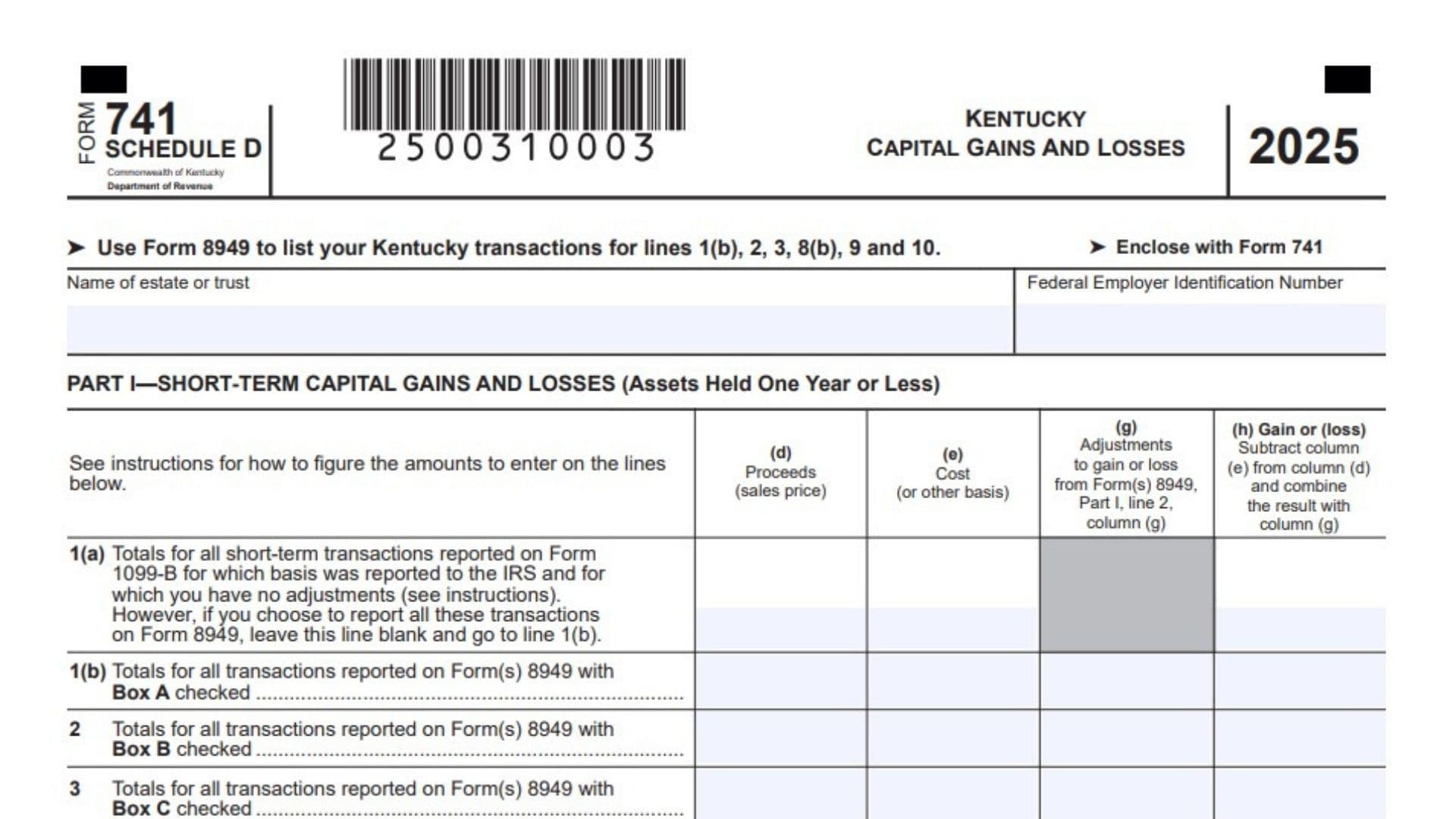
Kentucky Schedule D, Form 741, is used by an estate or trust to calculate and report capital gains and losses for Kentucky fiduciary income tax purposes. The schedule separates transactions into short-term assets held for one year or less and long-term assets held for more than one year. It begins with proceeds, cost or other basis, and applicable adjustments from Kentucky Form 8949, then includes capital gains or losses reported on federal forms, pass-through amounts from partnerships and S corporations, capital gain distributions, gains from the sale of business property, and unused capital losses carried forward from the previous year. After the short-term and long-term totals are calculated, the estate or trust divides the amounts between beneficiaries and the fiduciary and reports the combined result in the summary section. When Kentucky recognizes a capital gain that was not included on federal Form 1041, the additional gain may need to be entered as a Kentucky addition on Schedule M of Form 741. When the calculation produces a net capital loss, Schedule D determines the amount currently deductible and whether any unused short-term or long-term loss may be carried from 2025 into 2026. The schedule is not filed by itself. It is completed as part of the estate’s or trust’s Kentucky fiduciary income tax return and enclosed with Form 741. Kentucky Form 8949 must also be used to list transactions reported on Schedule D lines 1(b), 2, 3, 8(b), 9, and 10.
Who Should Complete Kentucky Schedule D?
An estate or trust should complete Kentucky Schedule D when it has capital asset sales, exchanges, distributions, carryovers, or other capital gain and loss items that must be reported for Kentucky tax purposes.
The schedule may be required when the entity has:
Short-term or long-term sales reported on Form 1099-B.
Transactions listed on Kentucky Form 8949.
Capital gains or losses from partnerships, S corporations, or other fiduciaries.
Capital gain distributions.
Gains reported on federal Form 4797.
Capital gains or losses from federal Forms 2439, 4684, 6252, 6781, or 8824.
Unused Kentucky capital losses carried forward from 2024.
A difference between the capital gain or loss recognized for federal and Kentucky tax purposes.
How To File Kentucky Schedule D
Complete the federal fiduciary return and gather all Forms 1099-B, federal Forms 8949, pass-through schedules, prior-year Kentucky carryover records, and other documents showing capital gains and losses.
Prepare Kentucky Form 8949 for the transactions that must be listed separately. Use Kentucky Form 8949 for the transactions summarized on Schedule D lines 1(b), 2, 3, 8(b), 9, and 10.
Transfer the applicable proceeds, basis, adjustments, and gains or losses to Parts I and II of Schedule D. Calculate the net short-term and long-term amounts, then complete the summary in Part III.
Complete Part IV if Part III produces a net capital loss. Complete Part V when the net loss is more than the current-year capital loss limitation and an unused amount may be carried into 2026.
Enclose the completed Schedule D with Kentucky Form 741. Also enclose all required Kentucky Forms 8949 and any supporting schedules used for pass-through amounts, basis adjustments, carryovers, or other capital gain and loss calculations.

How To Complete Kentucky Schedule D Form 741
Estate Or Trust Information
Name Of Estate Or Trust: Enter the full legal name of the estate or trust. Use the same name reported on Kentucky Form 741 and the federal fiduciary income tax return.
Federal Employer Identification Number: Enter the estate’s or trust’s federal employer identification number. Confirm that the number matches Form 741 and all related Kentucky schedules.
Understanding The Transaction Columns
The short-term and long-term sections use the same four transaction columns.
Column (d), Proceeds: Enter the gross sales price or other proceeds received from the transaction. Use the applicable amount from Form 1099-B, Form 8949, or other transaction records.
Column (e), Cost Or Other Basis: Enter the estate’s or trust’s adjusted cost or other tax basis in the property. Include permitted basis adjustments that apply before calculating the gain or loss.
Column (g), Adjustments: Enter the total adjustment from the corresponding Kentucky Form 8949 category. These adjustments may account for differences involving basis, excluded gains, disallowed losses, reporting corrections, or Kentucky-specific treatment.
Column (h), Gain Or Loss: Subtract column (e) from column (d), then combine the result with the adjustment in column (g). A positive result is a gain. A negative result is a loss.
The basic calculation is:
Proceeds minus cost or other basis, plus or minus adjustments, equals gain or loss.
Part I, Short-Term Capital Gains And Losses
Part I reports assets held for one year or less. Use the holding period applicable to each transaction when deciding whether an item belongs in Part I or Part II.
Lines 1(a) Through 7
Line 1(a): Enter the combined totals for short-term transactions reported on Form 1099-B when the basis was reported to the IRS and the transactions do not require adjustments. Enter total proceeds in column (d) and total cost or other basis in column (e). Because these transactions have no adjustments, column (g) should generally remain blank. Calculate the gain or loss in column (h). If every transaction in this category is being listed separately on Form 8949, leave line 1(a) blank and report the totals on line 1(b).
Line 1(b): Enter the totals from all attached Forms 8949 for short-term transactions with Box A checked. These are generally transactions for which basis was reported to the IRS. Enter the combined proceeds in column (d), basis in column (e), adjustments in column (g), and resulting gain or loss in column (h).
Line 2: Enter the totals from all attached Forms 8949 for short-term transactions with Box B checked. These are generally transactions reported on Form 1099-B for which basis was not reported to the IRS. Combine the proceeds, basis, adjustments, and gain or loss from every applicable Form 8949.
Line 3: Enter the totals from all attached Forms 8949 for short-term transactions with Box C checked. These are generally short-term transactions that were not reported on Form 1099-B. Include the combined proceeds, basis, adjustments, and gain or loss.
Line 4: Enter the net short-term capital gain or loss reported from applicable federal Forms 4684, 6252, 6781, and 8824. Combine all amounts from those forms that are treated as short-term capital items for Kentucky purposes.
Line 5: Enter the estate’s or trust’s net short-term capital gain or loss received from partnerships, S corporations, and other fiduciaries. Use the Kentucky amounts supplied on the applicable pass-through schedules. Combine gains and losses before entering the net amount.
Line 6: Enter the unused short-term capital loss carried forward from the 2024 Kentucky Schedule D, line 29. Enter the amount as a loss, generally using parentheses or a negative number. Do not enter a federal carryover unless it also represents the correct Kentucky carryover.
Line 7: Combine the amounts from lines 1(a) through 6 in column (h). Add all gains and subtract all losses. The result is the estate’s or trust’s net short-term capital gain or loss. Enter the same amount in Part III, line 17.
Part II, Long-Term Capital Gains And Losses
Part II reports assets held for more than one year.
Lines 8(a) Through 16
Line 8(a): Enter the combined totals for long-term transactions reported on Form 1099-B when basis was reported to the IRS and no adjustments are required. Enter proceeds in column (d), cost or other basis in column (e), and the resulting gain or loss in column (h). Leave column (g) blank when there are no adjustments. If all transactions in this category are listed separately on Form 8949, leave line 8(a) blank and report the totals on line 8(b).
Line 8(b): Enter the totals from all attached Forms 8949 for long-term transactions with Box D checked. Combine the proceeds, basis, adjustments, and gains or losses from all transactions in this category.
Line 9: Enter the totals from all attached Forms 8949 for long-term transactions with Box E checked. These are generally transactions reported on Form 1099-B for which basis was not reported to the IRS.
Line 10: Enter the totals from all attached Forms 8949 for long-term transactions with Box F checked. These are generally long-term transactions that were not reported on Form 1099-B.
Line 11: Enter the net long-term capital gain or loss from applicable federal Forms 2439, 4684, 6252, 6781, and 8824. Combine all amounts from those forms that receive long-term capital treatment for Kentucky purposes.
Line 12: Enter the net long-term capital gain or loss allocated to the estate or trust by partnerships, S corporations, and other fiduciaries. Use the Kentucky amounts reported by the pass-through entities.
Line 13: Enter capital gain distributions received by the estate or trust. These amounts may be reported on Forms 1099-DIV or other tax statements.
Line 14: Enter the applicable gain from federal Form 4797. Include only the portion treated as a long-term capital gain for purposes of this schedule.
Line 15: Enter the unused long-term capital loss carried forward from the 2024 Kentucky Schedule D, line 36. Report the amount as a loss, generally using parentheses or a negative number.
Line 16: Combine lines 8(a) through 15 in column (h). Add the long-term gains and subtract the long-term losses. The result is the net long-term capital gain or loss. Enter the same amount in Part III, line 18.
Part III, Summary Of Short-Term And Long-Term Results
Part III summarizes the results from Parts I and II and divides them between the beneficiaries and the estate or trust.
The section contains three columns.
Column 1, Beneficiaries: Enter the portion of each capital gain or loss allocated to beneficiaries. The amounts should agree with the beneficiary allocation calculations and the Kentucky Schedules K-1 issued by the estate or trust.
Column 2, Estate Or Trust: Enter the portion retained and reportable by the estate or trust.
Column 3, Total: Add columns 1 and 2. The result should equal the total capital gain or loss calculated in Parts I and II.
Lines 17 Through 19
Line 17: Enter the net short-term capital gain or loss from Part I, line 7. Divide the amount between beneficiaries in column 1 and the estate or trust in column 2. Enter the combined amount in column 3. Column 3 should match line 7.
Line 18: Enter the net long-term capital gain or loss from Part II, line 16. Divide the amount between beneficiaries and the estate or trust, then enter the total in column 3. Column 3 should match line 16.
Line 19: Combine lines 17 and 18 in each column. Add gains and subtract losses. Column 1 shows the total net capital gain or loss allocated to beneficiaries. Column 2 shows the amount retained by the estate or trust. Column 3 shows the total Kentucky net capital gain or loss.
If line 19, column 3, shows a net gain that was not reported on federal Form 1041, enter that additional gain on Form 741, Schedule M, line 3.
If line 19, column 3, shows a net loss, complete Part IV.
Part IV, Computation Of Capital Loss Limitation
Part IV determines the amount of a net capital loss that may be used for the current tax year.
Line 20: Compare the net loss on line 19, column 3, with $3,000. Enter the smaller loss amount. The deduction cannot exceed $3,000. Report the amount as a loss, generally using parentheses.
When part of the allowable Kentucky loss is not already reported on federal Form 1041, enter the additional loss on Form 741, Schedule M, line 7.
If the net loss on line 19, column 3, is more than $3,000, complete Part V to determine the amount carried forward from 2025 into 2026.
Part V, Computation Of Capital Loss Carryovers From 2025 To 2026
Part V calculates the unused short-term and long-term capital losses that may be carried into the next taxable year.
Section A, Computation Of Carryover Limit
Section A determines how much of the capital loss was absorbed in the current year before the short-term and long-term carryovers are calculated.
Line 21: Enter the estate’s or trust’s taxable income or loss for 2025 from Form 741. Use the amount from the completed fiduciary return before calculating the capital loss carryover.
Line 22: Enter the loss from line 20 as a positive number. Remove the parentheses or negative sign when transferring the amount.
Line 23: Combine lines 21 and 22. If the calculation produces a negative amount, enter zero. Do not report an amount below zero.
Line 24: Compare lines 22 and 23. Enter the smaller amount. This is the portion used in determining how much capital loss remains available for carryover.
Section B, Short-Term Capital Loss Carryover
Complete Section B only when line 7 shows a short-term capital loss and line 19, column 3, shows an overall net capital loss.
Line 25: Enter the short-term capital loss from Part I, line 7, as a positive number. Do not include parentheses or a negative sign.
Line 26: Enter the net long-term capital gain from line 16. If line 16 is blank or shows a long-term loss, enter zero.
Line 27: Enter the amount from line 24.
Line 28: Add lines 26 and 27.
Line 29: Subtract line 28 from line 25. If the result is zero or negative, enter zero. A positive result is the short-term capital loss carryover from 2025 to 2026. Retain this amount for the 2026 Kentucky Schedule D.
Section C, Long-Term Capital Loss Carryover
Complete Section C only when line 16 shows a long-term capital loss and line 19, column 3, shows an overall net capital loss.
Line 30: Enter the long-term capital loss from line 16 as a positive number. Remove any parentheses or negative sign.
Line 31: Enter the short-term capital gain from Part I, line 7. If line 7 is blank or shows a short-term loss, enter zero.
Line 32: Enter the amount from line 24.
Line 33: Enter the amount from line 25, when applicable. If no amount was entered on line 25, enter zero or leave the line blank as appropriate.
Line 34: Subtract line 33 from line 32. If the result is zero or negative, enter zero.
Line 35: Add lines 31 and 34.
Line 36: Subtract line 35 from line 30. If the result is zero or negative, enter zero. A positive result is the long-term capital loss carryover from 2025 to 2026. Retain this amount for the 2026 Kentucky Schedule D.
Kentucky Form 8949 Reporting Requirements
Use Kentucky Form 8949 to list the individual transactions summarized on the following Schedule D lines:
Line 1(b): Short-term transactions reported with Box A checked.
Line 2: Short-term transactions reported with Box B checked.
Line 3: Short-term transactions reported with Box C checked.
Line 8(b): Long-term transactions reported with Box D checked.
Line 9: Long-term transactions reported with Box E checked.
Line 10: Long-term transactions reported with Box F checked.
The totals from all Forms 8949 in each category must agree with the corresponding line of Schedule D. Enclose the completed Forms 8949 with Form 741.
Final Kentucky Schedule D Filing Checklist
Confirm that the estate’s or trust’s legal name and FEIN match Kentucky Form 741.
Verify that each asset was correctly classified as short-term or long-term.
Reconcile the proceeds and basis amounts with Forms 1099-B, Forms 8949, pass-through schedules, and transaction records.
Review every adjustment in column (g) and confirm that column (h) equals proceeds minus basis, combined with the adjustment.
Make sure all Forms 8949 required for lines 1(b), 2, 3, 8(b), 9, and 10 are enclosed.
Confirm that line 7 was transferred to Part III, line 17, and line 16 was transferred to Part III, line 18.
Verify that the allocations between beneficiaries and the estate or trust add to the totals in column 3.
Complete Part IV whenever line 19, column 3, shows a net capital loss.
Complete Part V when the total net capital loss exceeds the $3,000 limitation.
Retain the line 29 short-term carryover and line 36 long-term carryover for use on the 2026 Kentucky Schedule D.
Enclose Schedule D and all supporting forms and schedules with Kentucky Form 741.