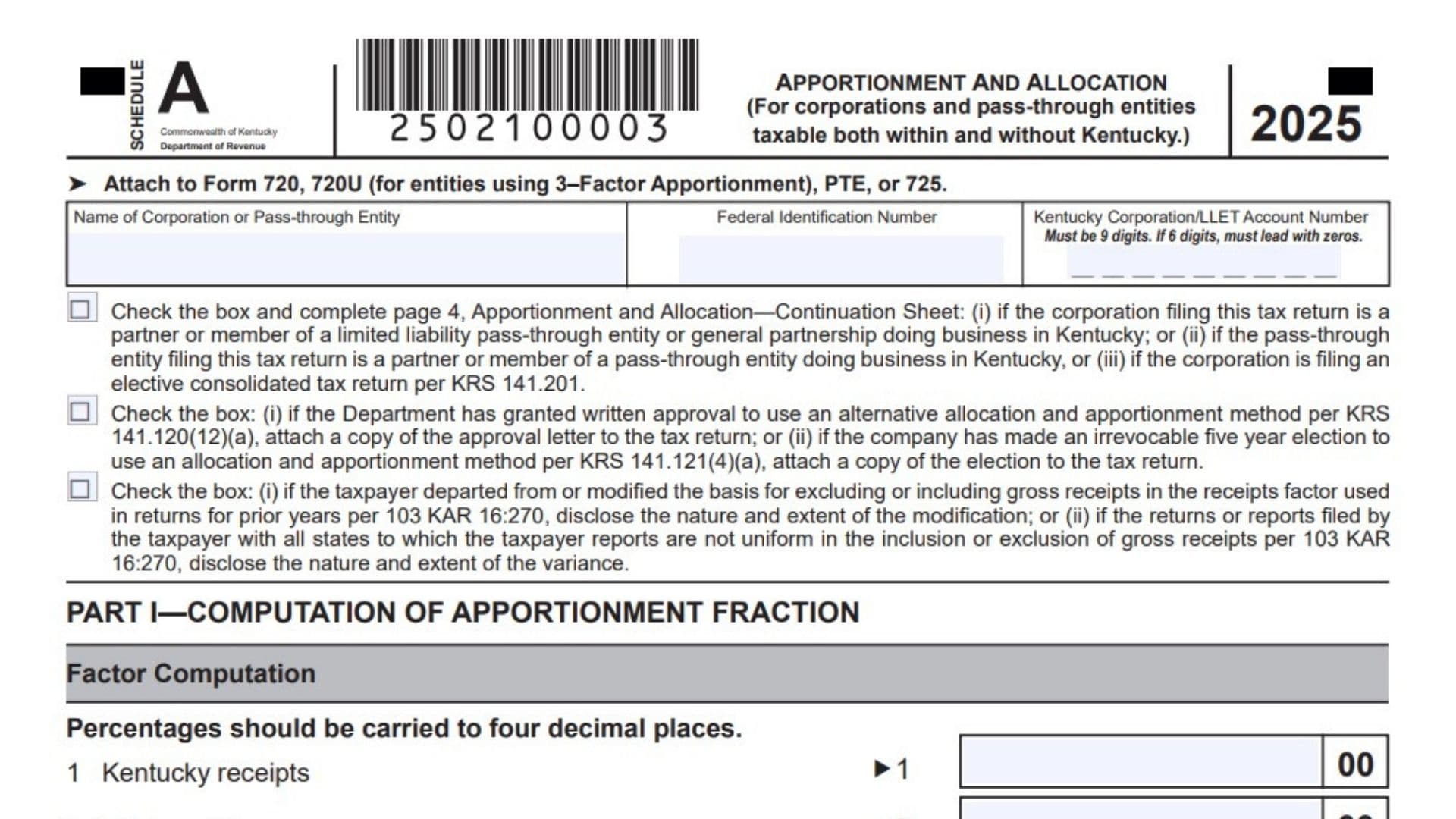
Kentucky Schedule A is used by corporations and certain pass-through entities that do business both within Kentucky and outside Kentucky to calculate the part of income taxable by Kentucky. The schedule helps determine the Kentucky apportionment percentage using receipts, property, and payroll factors, depending on the taxpayer’s required method. Most taxpayers use the receipts factor, while certain entities required under Kentucky law use a three-factor apportionment method that includes receipts, property, and payroll. Schedule A also separates apportionable income from non-apportionable income, allocates Kentucky non-apportionable income, and calculates taxable net income for Form 720. The form includes sections for computing Kentucky receipts, total receipts, Kentucky and total property values, Kentucky and total payroll, and continuation schedules for elective consolidated groups or entities that receive pass-through apportionment information. It is important because it prevents income from being taxed entirely by Kentucky when only part of the business activity belongs to Kentucky.
How To File Kentucky Schedule A
Attach Kentucky Schedule A to the applicable Kentucky return. For corporations, it is commonly attached to Form 720. It may also be attached to Form 720U for entities using three-factor apportionment, Form PTE, or Form 725 when applicable. If the taxpayer is part of an elective consolidated group, owns an interest in a pass-through entity doing business in Kentucky, or needs to report pass-through apportionment factors, complete the continuation sheet on page 4. If the Department of Revenue has approved an alternative apportionment method, attach the approval letter. If the taxpayer made an allowed election to use an alternative allocation and apportionment method, attach the election statement. If the taxpayer changed how gross receipts are included or excluded compared with prior years, disclose the nature and extent of the change. If the taxpayer’s reporting is not uniform across states, disclose the variance on the Kentucky return.

How To Complete Kentucky Schedule A (Form 720)
Top Section
Line 1: Schedule A
Use this schedule for Kentucky apportionment and allocation.
Line 2: Tax Year 2025
Use this version for the 2025 tax year.
Line 3: Commonwealth Of Kentucky Department Of Revenue
This identifies the Kentucky tax agency connected with the schedule.
Line 4: Apportionment And Allocation
This title shows that the schedule is used to divide and allocate income for Kentucky tax purposes.
Line 5: For Corporations And Pass-Through Entities Taxable Both Within And Without Kentucky
Use this schedule only when the entity has taxable activity both in Kentucky and outside Kentucky.
Line 6: Attach To Form 720, 720U, PTE, Or 725
Attach the completed schedule to the Kentucky tax return that applies to the entity.
Line 7: First Checkbox, Continuation Sheet Required
Check this box and complete page 4 if the corporation filing the return is a partner or member of a limited liability pass-through entity or general partnership doing business in Kentucky.
Line 8: First Checkbox, Pass-Through Entity Owner Rule
Check this box and complete page 4 if the pass-through entity filing the return is a partner or member of another pass-through entity doing business in Kentucky.
Line 9: First Checkbox, Elective Consolidated Return Rule
Check this box and complete page 4 if the corporation is filing an elective consolidated tax return.
Line 10: Second Checkbox, Alternative Method Approval
Check this box if written approval has been granted to use an alternative allocation or apportionment method. Attach the approval letter to the return.
Line 11: Second Checkbox, Five-Year Election
Check this box if the company made an irrevocable five-year election to use an allowed allocation and apportionment method. Attach a copy of the election to the return.
Line 12: Third Checkbox, Gross Receipts Method Changed
Check this box if the taxpayer changed the basis for including or excluding gross receipts in the receipts factor compared with prior years. Disclose the nature and extent of the change.
Line 13: Third Checkbox, Nonuniform State Reporting
Check this box if the taxpayer’s returns or reports filed with other states are not uniform in how gross receipts are included or excluded. Disclose the nature and extent of the difference.
Line 14: Name Of Corporation Or Pass-Through Entity
Enter the full legal name of the corporation or pass-through entity.
Line 15: Federal Identification Number
Enter the federal employer identification number of the entity.
Line 16: Kentucky Corporation/LLET Account Number
Enter the Kentucky Corporation/LLET account number.
Line 17: Account Number Formatting Rule
The Kentucky Corporation/LLET account number must contain 9 digits. If it has only 6 digits, add leading zeros at the beginning.
Line 18: Percentages Instruction
Carry percentage amounts to four decimal places.
Part I, Computation Of Apportionment Fraction
Line 1: Kentucky Receipts
Enter gross receipts assigned to Kentucky. Include Kentucky receipts from regular business transactions and activity, unless the receipts are excluded under the applicable gross receipts rules.
Line 2: Total Receipts
Enter total gross receipts everywhere, excluding non-apportionable receipts and any receipts that must be excluded under Kentucky rules.
Line 3: Receipts Factor
Divide Line 1 by Line 2 and enter the percentage. This shows the Kentucky portion of total receipts.
Line 4: Double-Weighted Receipts Factor
Multiply Line 3 by 2 and enter the result. This line is used in the three-factor formula for entities required to use that method.
Line 5: Average Value Of Kentucky Real/Tangible Property
Enter the total from Part III, Line 9. This is the average value of Kentucky real and tangible property, including the required value for leased property.
Line 6: Average Value Of Total Real/Tangible Property
Enter the total from Part IV, Line 9. This is the average value of real and tangible property everywhere.
Line 7: Property Factor
Divide Line 5 by Line 6 and enter the percentage. This shows the Kentucky portion of the entity’s real and tangible property.
Line 8: Kentucky Payrolls
Enter compensation paid or payable for services assigned to Kentucky.
Line 9: Total Payrolls
Enter total compensation paid or payable everywhere during the tax period.
Line 10: Payroll Factor
Divide Line 8 by Line 9 and enter the percentage. This shows the Kentucky portion of total payroll.
Line 11: Total
Add Lines 4, 7, and 10. This total is used for entities required to use the three-factor apportionment method.
Line 12: Apportionment Fraction
Enter the apportionment fraction for entities required to use three-factor apportionment. Entities not required to use three-factor apportionment generally use the percentage from Line 3.
Part II, Apportionment And Allocation Of Income, Form 720 Only
Line 1: Net Income
Enter net income from Form 720, Part I, Line 40.
Line 2(a): Deduct Non-Apportionable Income, Interest
Enter non-apportionable interest income, if applicable.
Line 2(b): Deduct Non-Apportionable Income, Rents
Enter non-apportionable rental income, if applicable.
Line 2(c): Deduct Non-Apportionable Income, Royalties
Enter non-apportionable royalty income, if applicable.
Line 2(d): Deduct Non-Apportionable Income, Net Gain Or Loss On Sale Or Exchange Of Capital Assets
Enter any non-apportionable net gain or loss from the sale or exchange of capital assets.
Line 2(e): Total Non-Apportionable Income
Add Lines 2(a) through 2(d) and enter the total.
Line 2(f): Related Expenses
Enter expenses directly or indirectly related to the non-apportionable income. Attach a supporting schedule.
Line 3: Net Non-Apportionable Income
Subtract Line 2(f) from Line 2(e) and enter the result.
Line 4: Apportionable Income
Subtract Line 3 from Line 1 and enter the result.
Line 5: Apportionable Income Apportioned To Kentucky
Multiply Line 4 by the proper Kentucky apportionment percentage. Most entities use Part I, Line 3. Entities required to use three-factor apportionment use Part I, Line 12.
Line 6(a): Add Kentucky Non-Apportionable Income, Interest
Enter Kentucky non-apportionable interest income, if applicable.
Line 6(b): Add Kentucky Non-Apportionable Income, Rents
Enter Kentucky non-apportionable rental income, if applicable.
Line 6(c): Add Kentucky Non-Apportionable Income, Royalties
Enter Kentucky non-apportionable royalty income, if applicable.
Line 6(d): Add Kentucky Non-Apportionable Income, Net Gain Or Loss On Sale Or Exchange Of Capital Assets
Enter Kentucky non-apportionable net gain or loss from the sale or exchange of capital assets.
Line 6(e): Total Kentucky Non-Apportionable Income
Add Lines 6(a) through 6(d) and enter the total.
Line 6(f): Kentucky Related Expenses
Enter expenses related to the Kentucky non-apportionable income. Attach a supporting schedule.
Line 7: Kentucky Net Non-Apportionable Income
Subtract Line 6(f) from Line 6(e) and enter the result.
Line 8: Taxable Net Income
Add Line 5 and Line 7. Enter the result here and on Form 720, Part I, Line 41.
Part III, Total Kentucky Real/Tangible Property
Line 1: Inventories
Enter the value of Kentucky inventories at the beginning of the year in Column A and at the end of the year in Column B.
Line 2: Buildings
Enter the value of Kentucky buildings at the beginning of the year in Column A and at the end of the year in Column B.
Line 3: Machinery And Equipment
Enter the value of Kentucky machinery and equipment at the beginning of the year in Column A and at the end of the year in Column B.
Line 4: Land
Enter the value of Kentucky land at the beginning of the year in Column A and at the end of the year in Column B.
Line 5: Other Tangible Assets
Enter the value of other Kentucky tangible assets at the beginning of the year in Column A and at the end of the year in Column B.
Line 6: Total
Add Lines 1 through 5 for Column A and Column B.
Line 7: Average Value Of Real/Tangible Property Owned In Kentucky
Add Line 6, Column A and Line 6, Column B, then divide by 2.
Line 8: Leased Property
Enter the value of Kentucky leased property. The value is eight times the annual rental rate, less subrentals.
Line 9: Total Kentucky Real/Tangible Property
Add Lines 7 and 8. Enter this amount on Part I, Line 5.
Part IV, Total Real/Tangible Property
Line 1: Inventories
Enter the value of inventories everywhere at the beginning of the year in Column A and at the end of the year in Column B.
Line 2: Buildings
Enter the value of buildings everywhere at the beginning of the year in Column A and at the end of the year in Column B.
Line 3: Machinery And Equipment
Enter the value of machinery and equipment everywhere at the beginning of the year in Column A and at the end of the year in Column B.
Line 4: Land
Enter the value of land everywhere at the beginning of the year in Column A and at the end of the year in Column B.
Line 5: Other Tangible Assets
Enter the value of other tangible assets everywhere at the beginning of the year in Column A and at the end of the year in Column B.
Line 6: Total
Add Lines 1 through 5 for Column A and Column B.
Line 7: Average Value Of Real/Tangible Property Owned Everywhere
Add Line 6, Column A and Line 6, Column B, then divide by 2.
Line 8: Leased Property
Enter the value of leased property everywhere. The value is eight times the annual rental rate, less subrentals.
Line 9: Total Real/Tangible Property Everywhere
Add Lines 7 and 8. Enter this amount on Part I, Line 6.
Schedule A Continuation Sheet
Line 1: Page Number
Enter the page number and total number of continuation pages.
Line 2: Elective Consolidated Group
Use Section A to report apportionment factors for members of an elective consolidated group.
Line 3: Pass-Through Entities
Use Section B to report apportionment factors received from pass-through entities.
Line 4: Column A, Name
Enter the name of the taxpayer, subsidiary, pass-through entity, or group member.
Line 5: Column B, Federal Identification Number
Enter the federal identification number for the listed entity.
Line 6: Column C, Kentucky Corporation/LLET Account Number
Enter the Kentucky Corporation/LLET account number for the listed entity, if applicable.
Line 7: Column D, Kentucky Receipts
Enter Kentucky receipts for the listed entity.
Line 8: Column E, Total Receipts
Enter total receipts for the listed entity.
Line 9: Column F, Average Value Of Kentucky Real/Tangible Property
Enter the listed entity’s average Kentucky real and tangible property.
Line 10: Column G, Average Value Of Total Real/Tangible Property
Enter the listed entity’s average real and tangible property everywhere.
Line 11: Column H, Kentucky Payrolls
Enter Kentucky payroll for the listed entity.
Line 12: Column I, Total Payrolls
Enter total payroll for the listed entity.
Section A, Elective Consolidated Group
Line 1: Taxpayer
Enter the parent company information on Line 1. If multiple continuation pages are used, enter Line 1 only on the first page.
Line 2: Group Member Entry
Enter information for a member of the elective consolidated group.
Line 3: Group Member Entry
Enter information for another member of the elective consolidated group, if applicable.
Line 4: Group Member Entry
Enter information for another member of the elective consolidated group, if applicable.
Line 5: Group Member Entry
Enter information for another member of the elective consolidated group, if applicable.
Line 6: Group Member Entry
Enter information for another member of the elective consolidated group, if applicable.
Line 7: Group Member Entry
Enter information for another member of the elective consolidated group, if applicable.
Line 8: Group Member Entry
Enter information for another member of the elective consolidated group, if applicable.
Line 9: Group Member Entry
Enter information for another member of the elective consolidated group, if applicable.
Line 10: Group Member Entry
Enter information for another member of the elective consolidated group, if applicable.
Line 11: Group Member Entry
Enter information for another member of the elective consolidated group, if applicable.
Line 12: Group Member Entry
Enter information for another member of the elective consolidated group, if applicable.
Line 13: Group Member Entry
Enter information for another member of the elective consolidated group, if applicable.
Line 14: Intercompany Eliminations
Enter intercompany transactions as negative amounts so they are removed from the consolidated apportionment factors.
Line 15: Section A Subtotal
Add Lines 2 through 14 on that continuation page only.
Line 16: Section A Total
If more than one continuation page is used, add the Line 15 subtotals from all pages and enter the total on the first continuation page.
Section B, Pass-Through Entities
Line 2: Pass-Through Entity Entry
Enter apportionment factor information received from a pass-through entity on Schedule K-1.
Line 3: Pass-Through Entity Entry
Enter information for another pass-through entity, if applicable.
Line 4: Pass-Through Entity Entry
Enter information for another pass-through entity, if applicable.
Line 5: Pass-Through Entity Entry
Enter information for another pass-through entity, if applicable.
Line 6: Pass-Through Entity Entry
Enter information for another pass-through entity, if applicable.
Line 7: Pass-Through Entity Entry
Enter information for another pass-through entity, if applicable.
Line 8: Pass-Through Entity Entry
Enter information for another pass-through entity, if applicable.
Line 9: Pass-Through Entity Entry
Enter information for another pass-through entity, if applicable.
Line 10: Pass-Through Entity Entry
Enter information for another pass-through entity, if applicable.
Line 11: Pass-Through Entity Entry
Enter information for another pass-through entity, if applicable.
Line 12: Pass-Through Entity Entry
Enter information for another pass-through entity, if applicable.
Line 13: Pass-Through Entity Entry
Enter information for another pass-through entity, if applicable.
Line 14: Section B Subtotal
Add Lines 2 through 13 on that continuation page only.
Line 15: Section B Total
If more than one continuation page is used, add the Line 14 subtotals from all pages and enter the total on the first continuation page.
Section C, Grand Total
Line 1: Grand Total Calculation
Add Line 1, Section A Line 16, and Section B Line 15.
Line 2: Carry Grand Total To Schedule A, Part I
Carry the grand total amounts to the matching lines in Schedule A, Part I.
Line 3: Continuation Sheet Checkbox
If the continuation sheet is used, check the proper box at the top of Schedule A, Page 1.
Receipts Factor Rules
Line 1: Total Receipts Rule
Total receipts generally include gross receipts from regular business transactions and business activity, except non-apportionable receipts and other receipts excluded under Kentucky rules.
Line 2: Kentucky Receipts Rule For Tangible Personal Property
Sales of tangible personal property are assigned to Kentucky if the property is delivered or shipped to a purchaser in Kentucky.
Line 3: U.S. Government Sales Rule
Sales of tangible personal property to the U.S. government are assigned to Kentucky if the property is shipped from Kentucky.
Line 4: Market-Based Sourcing Rule
Receipts other than tangible personal property sales are assigned to Kentucky if the taxpayer’s market for the sale is in Kentucky.
Line 5: Real Property Receipts Rule
Receipts from real property sold, rented, leased, or licensed are assigned to Kentucky to the extent the real property is located in Kentucky.
Line 6: Tangible Personal Property Rental Rule
Receipts from renting, leasing, or licensing tangible personal property are assigned to Kentucky to the extent the property is located in Kentucky.
Line 7: Service Receipts Rule
Receipts from services are assigned to Kentucky to the extent the service is delivered to a location in Kentucky.
Line 8: Intangible Property Rental Or License Rule
Receipts from renting, leasing, or licensing intangible property are assigned to Kentucky to the extent the intangible property is used in Kentucky.
Line 9: Marketing Intangible Rule
If intangible property is used to market a good or service, it is treated as used in Kentucky when the good or service is purchased by a consumer in Kentucky.
Line 10: Intangible Property Sale Rule
Receipts from selling intangible property are assigned to Kentucky to the extent the intangible property is used in Kentucky.
Line 11: Geographic Contract Right Rule
A contract right, government license, or similar intangible that allows business activity in a geographic area is used in Kentucky if the geographic area includes all or part of Kentucky.
Line 12: Contingent Intangible Receipts Rule
Receipts from sales of intangible property that depend on productivity, use, or disposition are treated like receipts from renting, leasing, or licensing the intangible property.
Line 13: Other Intangible Sale Receipts Rule
Other receipts from selling intangible property are excluded from both the numerator and denominator of the receipts factor.
Property Factor Rules
Line 1: Total Property Rule
Total property includes real and tangible personal property owned or rented and used during the taxable year.
Line 2: Owned Property Valuation Rule
Property owned by the taxpayer is valued at original cost.
Line 3: Leased Property Valuation Rule
Leased property is valued at eight times the annual rental rate, reduced by non-apportionable subrentals.
Line 4: Kentucky Property Assignment Rule
Real and tangible personal property is assigned to Kentucky if it is owned or rented and used in Kentucky.
Line 5: Construction In Progress Exclusion
Do not include construction in progress in the property factor.
Line 6: Pollution Control Facility Exclusion
Do not include property certified by Kentucky as a pollution control facility if it is owned or leased by the corporation.
Payroll Factor Rules
Line 1: Total Payroll Rule
Total payroll includes all compensation paid or payable by the corporation during the tax period.
Line 2: Kentucky Payroll Rule
Kentucky payroll includes compensation paid or payable for services performed in Kentucky.
Line 3: Entirely Kentucky Service Rule
Compensation is assigned to Kentucky if the employee’s service is performed entirely in Kentucky.
Line 4: Incidental Out-Of-State Service Rule
Compensation is assigned to Kentucky if the employee works inside and outside Kentucky, but the out-of-state work is only incidental to the Kentucky work.
Line 5: Base Of Operations Rule
Compensation is assigned to Kentucky if some service is performed in Kentucky and the employee’s base of operations, or the place from which the service is directed or controlled, is in Kentucky.
Line 6: Kentucky Residence Rule
If there is no base of operations or direction point in another state where part of the service is performed, compensation may be assigned to Kentucky if the employee lives in Kentucky.
Important Filing Rules
Line 1: Statutory Formula Rule
A corporation must use the statutory apportionment formula unless it has written approval or a valid election to use another method.
Line 2: Alternative Method Attachment Rule
Attach the written approval letter or election statement when filing under an alternative allocation or apportionment method.
Line 3: Elective Consolidated Group Rule
An affiliated group filing an elective consolidated return is treated as one corporation, and intercompany transactions must be eliminated.
Line 4: Form 720U Rule
Attach Schedule A to Form 720U only for entities using three-factor apportionment. Other members generally compute apportionment factors on the appropriate Form 720U schedule.
Line 5: Page 4 Requirement For Corporation Owners
Complete the continuation sheet if the corporation or any corporation in an affiliated group owns an interest in a limited liability pass-through entity or general partnership doing business in Kentucky.
Line 6: Page 4 Requirement For Pass-Through Entity Owners
Complete the continuation sheet if the pass-through entity filing Schedule A owns an interest in another pass-through entity doing business in Kentucky.
Line 7: Section C Transfer Rule
When page 4 is required, transfer the amounts from Section C to the corresponding lines of Schedule A, Part I.
Line 8: Three-Factor Entity Transfer Rule
Entities required to use three-factor apportionment must transfer the applicable receipts, property, and payroll amounts from Section C to the corresponding lines on Schedule A, Part I.
Line 9: Apportionable Income Rule
Apportionable income comes from the regular course of the corporation’s trade or business, including income from property connected with business operations.
Line 10: Non-Apportionable Income Rule
Non-apportionable income is income other than apportionable income, reduced by direct or indirect expenses related to producing that income.
Line 11: Income Category Warning
Do not decide whether income is apportionable only by its label. Interest, rents, royalties, and capital gains may be apportionable or non-apportionable depending on their connection to the business.
Line 12: Final Form 720 Entry
After completing Part II, enter taxable net income from Part II, Line 8 on Form 720, Part I, Line 41.