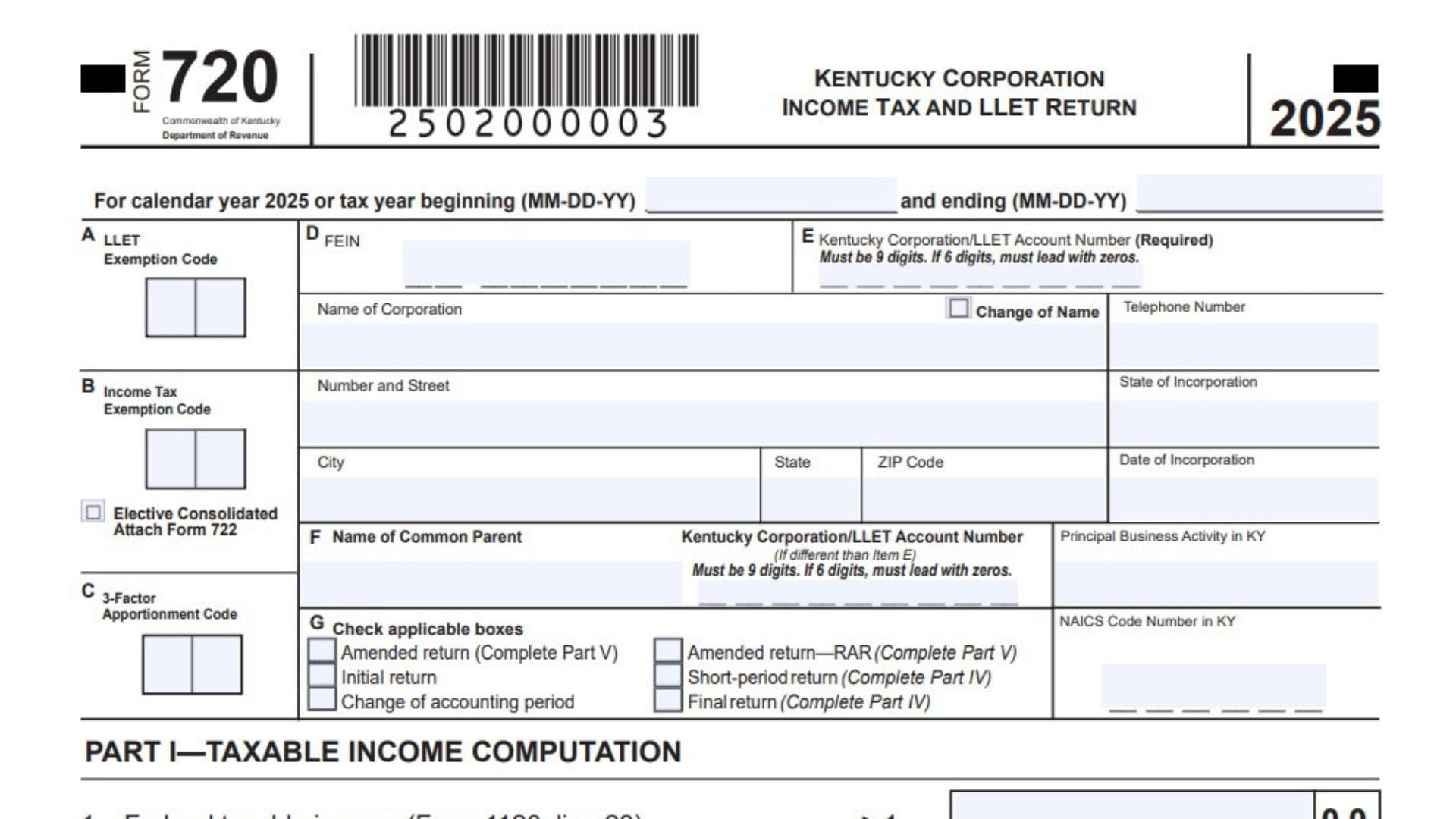
Kentucky Form 720 is the main tax return used by corporations to report Kentucky corporation income tax and, when applicable, the Limited Liability Entity Tax, often called LLET. It is used by C corporations doing business in Kentucky, corporations with income from Kentucky sources, and certain entities that must calculate LLET based on Kentucky gross receipts or gross profits. This return combines several important pieces into one filing, including the taxable income computation, the LLET computation, the corporation income tax computation, final return or short-period explanations, amended return explanations, a questionnaire, and Schedule L for LLET. In practice, this means the form is not just a simple income tax return. It also serves as a compliance document that helps Kentucky confirm the business’s filing status, ownership details, nexus with the state, credits, payments, overpayments, officer information, and whether the corporation has relationships with pass-through entities or unitary business members. If a corporation is required to file in Kentucky, this form is one of the most important annual filings because errors on income, credits, estimated payments, or LLET can affect tax due, refunds, and future carryforwards.
How To File Kentucky Form 720
Complete the return for the correct taxable year and attach the required federal return with all supporting schedules and statements. If applicable, also attach Schedule TCS, Schedule DE, Schedule COGS, Schedule L-C, Form 2220-K, and any supporting statements required for special lines. If you owe tax and are sending a payment, mail the return with payment to the Kentucky Department of Revenue, Frankfort, KY 40620-0021. If no payment is enclosed and you are claiming a refund or filing a no-payment return, mail it to Kentucky Department of Revenue, Frankfort, KY 40618-0010. Make checks payable to Kentucky State Treasurer. Electronic payment options are also available through the Kentucky Department of Revenue website. The return must be signed by an authorized corporate officer, and if a paid preparer completed it, that preparer must also sign the form and provide the requested identifying information.

How To Complete Kentucky Form 720
Part I, Taxable Income Computation
Line 1: Enter federal taxable income from the corporation’s federal return, adjusted only as Kentucky requires for this starting point.
Line 2: Enter state taxes measured by income that were deducted on the federal return if Kentucky requires them to be added back.
Line 3: Enter the depreciation adjustment amount if Kentucky depreciation differs from the federal depreciation claimed.
Line 4: Enter the deduction for related party expenses that must be added back under Kentucky law, if applicable.
Line 5: Enter any intangible expense addback required by Kentucky rules.
Line 6: Enter interest expense paid to a related party that must be added back if Kentucky law disallows the deduction.
Line 7: Enter any safe harbor lease adjustment that applies.
Line 8: Enter any difference caused by bonus depreciation or Section 179 treatment if Kentucky requires an addition.
Line 9: Enter any amount related to domestic production deductions or similar federal deductions that Kentucky requires to be adjusted.
Line 10: Enter any other Kentucky-specific income addition required for the corporation.
Line 11: Enter any other federal deduction that must be reversed for Kentucky purposes.
Line 12: Enter any additional adjustment not already included above that increases federal taxable income for Kentucky.
Line 13: Enter the federal contribution deduction taken on federal Form 1120, line 19.
Line 14: Enter Terminal Railroad Corporation adjustments if they apply to your corporation.
Line 15: Enter the federal passive activity loss that was allowed federally but must be added back for Kentucky purposes.
Line 16: Enter the federal taxable loss of any exempt corporations included in the federal consolidated figures if Kentucky requires this adjustment.
Line 17: Leave this line blank unless Kentucky later assigns a use for it. It is reserved for future use.
Line 18: Enter additions coming from Kentucky Schedule K-1 forms, if the corporation received Kentucky pass-through income items that require an addition.
Line 19: Enter Internal Revenue Code adjustments required by Kentucky if the state decouples from a federal provision.
Line 20: Enter other additions not specifically listed above, and attach a clear explanation.
Line 21: Add lines 1 through 20 and enter the total additions-adjusted amount.
Line 22: Enter interest income from U.S. obligations that Kentucky allows you to subtract.
Line 23: Enter dividend income that Kentucky allows as a subtraction.
Line 24: Leave blank unless Kentucky later assigns it a purpose. It is reserved for future use.
Line 25: Enter the Kentucky depreciation subtraction adjustment if Kentucky allows a subtraction here.
Line 26: Enter any Revenue Agent Report adjustment that decreases income for Kentucky purposes.
Line 27: Enter capital gain from federal Form 1120, line 8, if it must be removed in arriving at Kentucky taxable income.
Line 28: Enter gain from federal Form 4797 included on federal Form 1120, line 9, if Kentucky requires a subtraction.
Line 29: Enter the loss from Kentucky Form 4797, Part II, line 17, if applicable.
Line 30: Enter 50 percent of gross royalty income from coal disposed of with a retained economic interest under IRC Section 631(c), along with applicable IRC Section 272 expenses, if the corporation elects not to use percentage depletion.
Line 31: Enter Terminal Railroad Corporation subtraction adjustments, if applicable.
Line 32: Enter the Kentucky allowable passive activity loss.
Line 33: Enter Kentucky allowable depletion.
Line 34: Enter the Kentucky contribution deduction.
Line 35: Leave blank unless Kentucky later gives it a use. It is reserved for future use.
Line 36: Enter the federal taxable income of exempt corporations if Kentucky allows it as a subtraction.
Line 37: Enter subtractions from Kentucky Schedule K-1 forms.
Line 38: Enter Internal Revenue Code subtraction adjustments required for Kentucky purposes.
Line 39: Enter any other subtraction not already listed, and attach an explanation.
Line 40: Subtract lines 22 through 39 from line 21. This is your Kentucky net income.
Line 41: Enter taxable net income as computed under Kentucky rules. This may require special treatment depending on apportionment or allocation.
Line 42: Enter the net operating loss deduction allowed for Kentucky.
Line 43: Subtract line 42 from line 41. This is taxable net income after the Kentucky NOLD.
Part II, LLET Computation
Line 1: Enter the amount from Schedule L, Section E, line 1.
Line 2: Enter any LLET tax credit recapture.
Line 3: Add lines 1 and 2.
Line 4: Enter nonrefundable LLET credit from Kentucky Schedule K-1 forms.
Line 5: Enter nonrefundable tax credits and attach Schedule TCS.
Line 6: Subtract lines 4 and 5 from line 3, then compare the result to the $175 minimum tax. Enter the greater amount.
Line 7: Leave blank if it remains reserved.
Line 8: Enter Kentucky estimated LLET payments made for the year.
Line 9: Enter refundable tax credits and attach Schedule TCS.
Line 10: Leave blank if it remains reserved.
Line 11: Enter any extension payment made for LLET.
Line 12: Enter any prior year tax credit applied to this year’s LLET.
Line 13: Enter income tax overpayment from Part III, line 17, if it was credited to LLET.
Line 14: Enter LLET paid on the original return if this is an amended return.
Line 15: Enter LLET overpayment shown on the original return if this is an amended filing.
Line 16: Enter estimated tax penalty and attach Form 2220-K if required.
Line 17: Compute LLET and penalty due by combining lines 6, 15, and 16, then subtracting lines 7 through 14.
Line 18: If payments and credits exceed the liability, enter the overpayment here.
Line 19: Enter the portion of LLET overpayment you want credited to 2025 income tax.
Line 20: Enter the amount you want credited to 2025 interest.
Line 21: Enter the amount you want credited to 2025 late file or pay penalty.
Line 22: Enter the amount you want applied to 2026 LLET.
Line 23: Subtract lines 19 through 22 from line 18. This is the LLET refund amount.
Part III, Income Tax Computation
Line 1: Compute and enter Kentucky corporation income tax based on taxable net income and the applicable Kentucky tax rate.
Line 2: Enter tax credit recapture for corporation income tax if required.
Line 3: Enter the LIFO recapture installment amount if Kentucky requires it.
Line 4: Add lines 1 through 3.
Line 5: Enter the nonrefundable LLET credit from the Corporation LLET Credit Worksheet, if applicable.
Line 6: Enter the nonrefundable LLET credit from Part II, line 6, reduced by $175.
Line 7: Enter nonrefundable tax credits and attach Schedule TCS.
Line 8: Subtract lines 5 through 7 from line 4, but do not go below zero. This is net income tax liability.
Line 9: Enter estimated income tax payments made during the year.
Line 10: Enter any extension payment made for corporation income tax.
Line 11: Enter any prior year credit applied to this year’s income tax.
Line 12: Enter the LLET overpayment from Part II, line 19, if it was applied to income tax.
Line 13: Enter corporation income tax paid on the original return if amending.
Line 14: Enter corporation income tax overpayment shown on the original return if amending.
Line 15: If tax still remains due after credits and payments, enter the amount due.
Line 16: If payments and credits exceed tax, enter the overpayment.
Line 17: Enter the portion of the overpayment you want credited to 2025 LLET.
Line 18: Enter the portion credited to 2025 interest.
Line 19: Enter the portion credited to 2025 late file or pay penalty.
Line 20: Enter the portion credited to 2026 corporation income tax.
Line 21: Subtract lines 17 through 20 from line 16. This is the refund amount.
Part IV, Explanation Of Final Return And Or Short-Period Return
Complete this section if the corporation is filing a final return or a short-period return. Explain why the filing period is shorter than a normal tax year or why the corporation is ceasing to file in Kentucky.
Part V, Explanation Of Amended Return Changes
If this is an amended return, check the box or boxes that apply, such as ceased operations in Kentucky, change in filing status, change of ownership, merger, successor to previous business, or other. If you choose other, clearly describe the reason for the amendment.
Signature Section
The authorized officer must sign and date the return. Print the officer’s name and title. If a paid preparer completed the form, that preparer must also sign and date it, print the preparer or firm name, enter the ID number, and provide email address and or telephone number. Check the box to indicate whether the Department of Revenue may discuss the return with the preparer.
Officer Information
Provide the president’s name, home address, Social Security number, and the date the individual became president. Attach a separate schedule listing the vice president, secretary, and treasurer with each person’s name, home address, and Social Security number. Also indicate whether the attached officer information changed from the last filed return.
Schedule Q, Questionnaire
Question 1: If this is the initial return or there was no return filed last year under the same name and FEIN, indicate whether the corporation is a new business or a successor to a previous business. If it is a successor, identify whether the previous business was a corporation, partnership, sole proprietorship, or another type, and provide the requested information.
Question 2: If the corporation is foreign, enter the date it became qualified to do business in Kentucky.
Question 3: Enter who keeps the corporation’s books.
Question 4: Indicate whether disregarded entities are included in this return. If yes, attach Schedule DE.
Question 5: Indicate whether the corporation was a partner or member in a pass-through entity doing business in Kentucky. If yes, list the names and FEINs of those entities.
Question 6: Indicate whether the corporation did business in Kentucky other than through an interest in a pass-through entity.
Question 7: Indicate whether the corporation owned more than 50 percent of another corporation’s voting stock as part of a unitary business. If yes, list the entity name and FEIN.
Question 8: Indicate whether more than 50 percent of this corporation’s voting stock was owned by another corporation that is part of a unitary business. If yes, list the names and FEINs. Attach a separate statement if more than three companies are involved.
Question 9: Check whether the attached federal return is a pro forma federal return or a copy of the federal return actually filed with the IRS.
Question 10: Indicate whether the return was prepared on a cash basis, accrual basis, or another method. If another method applies, describe it.
Schedule L, Limited Liability Entity Tax Computation
Section A, Computation Of Kentucky Gross Receipts And Gross Profits
Line 1(a): Enter gross receipts from Kentucky sources before reductions.
Line 1(b): Enter Kentucky statutory gross receipts reductions.
Line 2: Subtract line 1(b) from line 1(a). This is adjusted Kentucky gross receipts.
Line 3(a): Enter cost of goods sold and attach Schedule COGS.
Line 3(b): Enter Kentucky statutory reductions to cost of goods sold.
Line 4: Subtract line 3(b) from line 3(a). This is adjusted cost of goods sold.
Line 5: Subtract line 4 from line 2. This is Kentucky gross profits.
Section B, Computation Of Total Gross Receipts And Gross Profits
Line 1: Enter total adjusted gross receipts from all sources.
Line 2: Enter total cost of goods sold from all sources and attach Schedule COGS if required.
Line 3: Subtract line 2 from line 1. This is total gross profits from all sources.
If Section B, line 1 or line 3 is $3,000,000 or less, skip Sections C and D, enter $175 in Section E, line 1, and also enter $175 on Part II, line 1.
Section C, Computation Of Gross Receipts LLET
Line 1: If total gross receipts from all sources are more than $3,000,000 but less than $6,000,000, use the formula shown on the form to calculate the gross receipts LLET.
Line 2: If total gross receipts from all sources are $6,000,000 or more, multiply Section A, line 2 by 0.00095.
Line 3: Enter the amount from line 1 or line 2.
Section D, Computation Of Gross Profits LLET
Line 1: If total gross profits from all sources are more than $3,000,000 but less than $6,000,000, use the formula shown on the form to calculate the gross profits LLET.
Line 2: If total gross profits from all sources are $6,000,000 or more, multiply Section A, line 5 by 0.0075.
Line 3: Enter the amount from line 1 or line 2.
Section E, Computation Of LLET
Line 1: Enter the smaller of Section C, line 3 or Section D, line 3. If the result is less than $175, enter the $175 minimum instead. Also carry this amount to Part II, line 1.