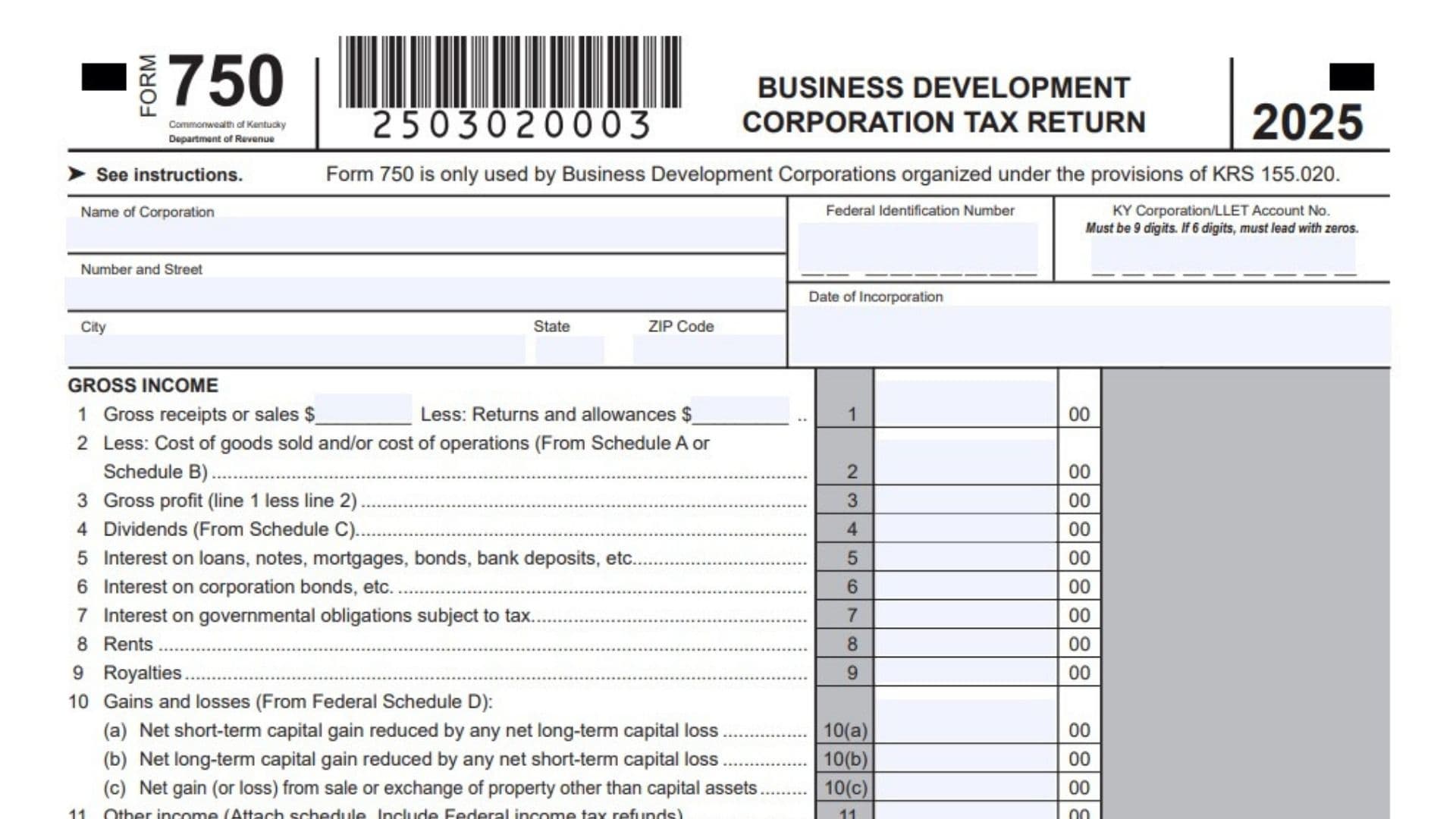
Kentucky Form 750 serves as the official tax return specifically designed for Business Development Corporations authorized under Chapter 155 of the Kentucky Revised Statutes. This form calculates the corporation’s tax liability using book income as the basis for taxable net income, rather than requiring federal tax adjustments or special treatments typically needed for other corporate returns. Corporations filing this return pay the determined tax amount in full when submitting, and this payment substitutes for both the standard state income tax under KRS 141.040 and the additional tax under KRS 141.0401. The form captures gross income and deductions exactly as maintained in the corporation’s regular accounting records, excluding only income specifically exempted by the Kentucky Constitution or U.S. Constitution and laws. Detailed schedules support calculations for cost of goods sold, officer compensation, depreciation, bad debts, balance sheets, and earned surplus analysis, ensuring comprehensive reporting of the corporation’s financial position and tax obligations. This specialized return must be filed by June 1 following the calendar year-end, with payments made payable to the Kentucky State Treasurer and sent to the Department of Revenue in Frankfort.
How To File Form 750
File Form 750 by June 1 after the close of the calendar year. Submit the completed return along with full payment of the calculated tax liability. Make checks payable to “Kentucky State Treasurer” and mail everything to the Department of Revenue, Frankfort, Kentucky 40620-0020. Include all required schedules and supporting documentation. Answer all questions on page 4 completely.

How To Complete Form 750
Enter book income and deductions directly from accounting records without income tax adjustments. Use schedules for detailed breakdowns of specific items. Complete page 1 first, then supporting schedules as needed. Transfer totals from schedules to the main form lines. Attach additional schedules where required.
Line 1: Report total cash on hand at year-end and beginning of year in the balance sheet section.
Line 2: Enter notes and accounts receivable amounts. Subtract reserve for bad debts on the sub-line.
Line 3a: Show inventory value using methods other than last-in, first-out.
Line 3b: Report last-in, first-out inventory valuation.
Line 4: Enter prepaid expenses and supplies for both periods.
Line 5: List investments generating nontaxable income.
Line 6: Report other investments with attached schedule.
Line 7: Show buildings and fixed depreciable assets. Subtract accumulated depreciation.
Line 8: Enter depletable assets. Subtract accumulated depletion.
Line 9: Report land value.
Line 10: List intangible amortizable assets. Subtract accumulated amortization.
Line 11: Enter other assets with attached schedule.
Line 12: Calculate total assets by adding all asset lines.
Line 13: Report accounts payable.
Line 14a: Show bonds, notes, and mortgages payable with maturity under one year.
Line 14b: Enter bonds, notes, and mortgages with maturity of one year or longer.
Line 15: List accrued expenses with attached schedule.
Line 16: Report other liabilities with attached schedule.
Line 17a: Enter preferred stock details including shares and shareholders.
Line 17b: Report common stock shares and shareholders.
Line 18: Show paid-in or capital surplus.
Line 19: List surplus reserves with attached schedule.
Line 20: Enter earned surplus and undivided profits.
Line 21: Total liabilities and capital.
Schedule A Line 1: Enter beginning year inventory where applicable.
Schedule A Line 2: Report merchandise bought for manufacture or sale.
Schedule A Line 3: List salaries and wages.
Schedule A Line 4: Enter other costs per books with submitted schedule.
Schedule A Line 5: Total all cost components.
Schedule A Line 6: Subtract ending year inventory.
Schedule A Line 7: Calculate cost of goods sold for page 1 line 2.
Schedule B Line 1: Enter salaries and wages where inventories not income-determining.
Schedule B Lines 2-6: Detail other costs (a through e).
Schedule B Line 7: Total cost of operations for page 1 line 2.
Schedule C: Report dividend income details.
Schedule E Column 1: List declaring corporation name.
Schedule E Column 2: Enter domestic corporations compensation.
Schedule E Column 3: Report foreign corporations compensation.
Schedule E Column 4: Show other corporations compensation.
Schedule E Totals: Sum compensation columns for page 1 line 13.
Schedule F Line 1: Taxable year identification.
Schedule F Line 2: Beginning year receivables.
Schedule F Line 3: End of year receivables.
Schedule F Line 4: Net income reported.
Schedule F Line 5: Sales on account.
Schedule F Line 6: Bad debts without reserve.
Schedule F Line 7: Reserve additions.
Schedule F Line 8: Reserve charges.
Schedule G: List taxes paid excluding federal income taxes.
Schedule H: Detail contributions or gifts by organization and amount.
Schedule H Total: Enter on page 1 line 19.
Schedule I Part A Line 1: Straight line depreciation method.
Schedule I Part A Line 2: Declining balance method.
Schedule I Part A Line 3: Sum of years digits method.
Schedule I Part A Line 4a: Units of production depreciation.
Schedule I Part A Line 4b: Hours of machine operation.
Schedule I Part A Line 5: Other depreciation methods.
Schedule I Part A Line 6: Total depreciation claimed.
Schedule I Part B Line 7: Emergency facilities amortization.
Schedule I Part B Line 8: Grain storage facilities.
Schedule I Part B Line 9: Research or experimental expenditures.
Schedule I Part B Line 10: Exploration and development expenditures.
Schedule I Part B Line 11: Organizational expenditures.
Schedule I Part B Line 12: Total amortization claimed.
Schedule I Part C Line 13: Sum depreciation and amortization.
Schedule I Part C Line 14: Subtract amounts claimed elsewhere.
Schedule I Part C Line 15: Balance for page 1 line 22.
Schedule J: List other deductions total for page 1 line 26.
Schedule K Assets: Complete balance sheet assets section.
Schedule K Liabilities: Complete balance sheet liabilities and capital section.
Schedule L Line 1: Earned surplus at prior year close.
Schedule L Line 2: Taxable net income from page 1 line 30.
Schedule L Line 3a: Kentucky obligations credit.
Schedule L Line 3b: U.S. obligations credit.
Schedule L Line 4: Sundry earned surplus credits with schedule.
Schedule L Line 5: Total credits.
Schedule L Line 6a: Cash distributions to stockholders.
Schedule L Line 6b: Stock distributions.
Schedule L Line 6c: Other property distributions.
Schedule L Line 7: Sundry debits with schedule.
Schedule L Line 8: Other unallowable deductions with schedule.
Schedule L Line 9: Total debits.
Schedule L Line 10: Ending earned surplus.
Question 1: Indicate if corporation filed under same name last year.
Question 2: Provide Kentucky principal office address.
Question 3: Name person maintaining books and location.
Question 4: Check cash or accrual basis.
Question 5: Enter Kentucky Employer Withholding Number.
Question 6: Indicate sales tax permit status and number.
Question 7: Report IRS changes to taxable income.