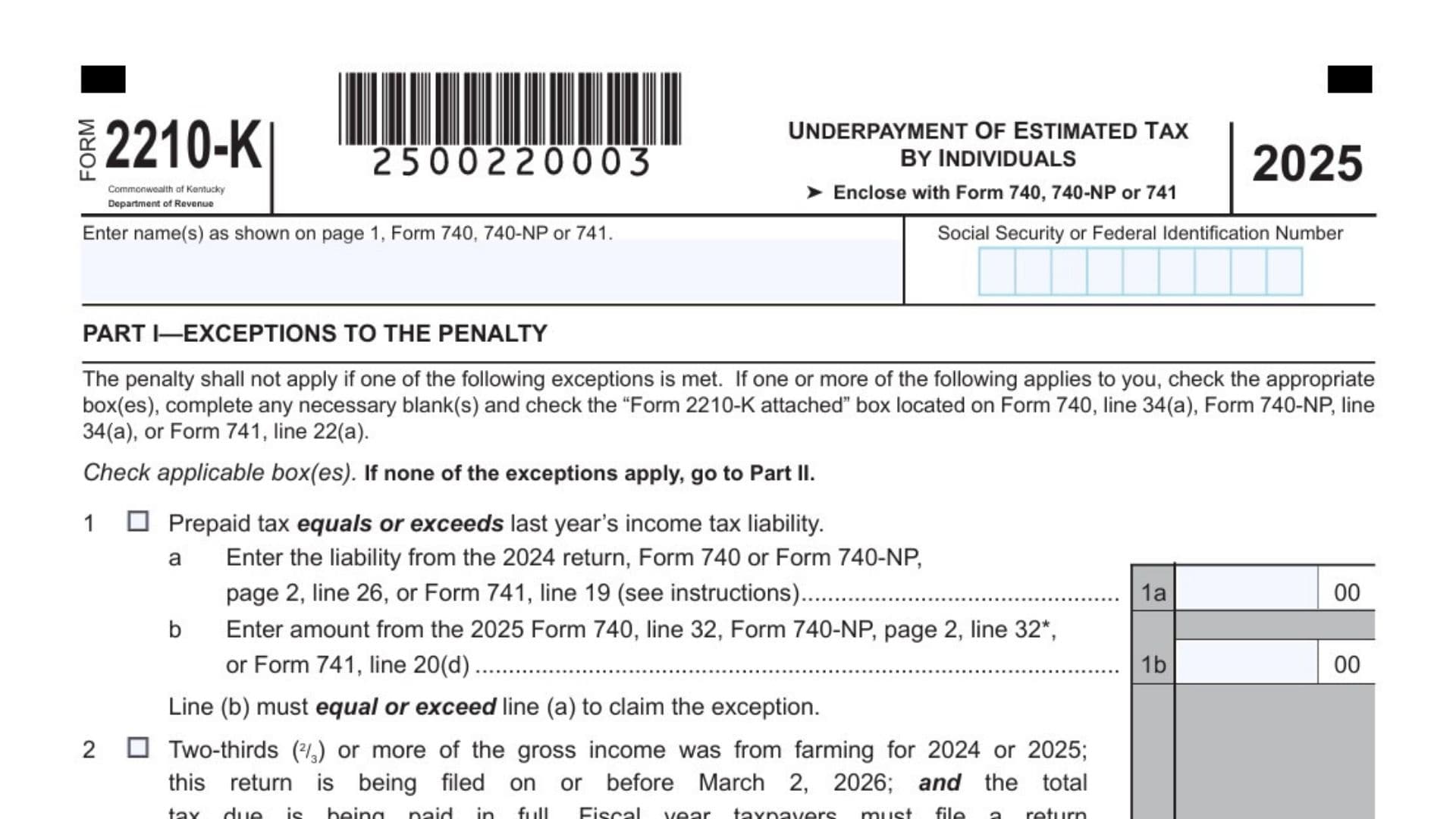
Kentucky Form 2210-K is the Underpayment of Estimated Tax by Individuals form used to determine whether a Kentucky taxpayer owes a penalty for not paying enough estimated tax during the year. When a person receives income that is not fully covered by withholding, such as self-employment income, investment income, rental income, or other sources with little or no tax withheld, Kentucky generally requires quarterly estimated tax payments throughout the year. If those payments were too small, too late, or not made at all, and the resulting underpayment exceeds five hundred dollars, a penalty may apply. Form 2210-K calculates that penalty precisely by checking whether total prepayments met the required threshold, identifying any shortfall across each quarterly period, and multiplying each underpayment by the applicable annual percentage rate for the number of days it remained unpaid. The form is organized into three main sections. Part I checks whether any exception removes the penalty entirely. Part II calculates the required annual payment and spreads it across four quarterly installments to find any underpayment in each period. Part III is optional and is used when income was uneven throughout the year, allowing the taxpayer to use an annualized method to reduce or eliminate the penalty on one or more installments. The form is attached to Form 740, Form 740-NP, or Form 741 depending on the taxpayer’s filing type, and it must be enclosed with the return when the penalty box is checked.
Who Must File Form 2210-K
You may owe a penalty for 2025 if your unpaid tax after withholding and timely estimated payments is more than five hundred dollars and your total prepayments did not equal at least the smaller of ninety percent of your 2025 Kentucky tax liability or one hundred percent of your 2024 Kentucky tax liability. Higher income taxpayers whose 2024 Kentucky adjusted gross income exceeded one hundred fifty thousand dollars, or seventy-five thousand dollars for married filing separately, must use one hundred ten percent of the prior year tax instead of one hundred percent. Farmers and fishermen with at least two-thirds of Kentucky gross income from those activities may substitute sixty-six and two-thirds percent for ninety percent.
How To File Form 2210-K
Complete all required parts of the form, check the Form 2210-K attached box on your main Kentucky return, and enclose Form 2210-K with your filed return. If you are using the Annualized Income Installment Method in Part III, check the box provided at the top of Part II before proceeding to Part III.

How to Complete Kentucky Form 2210-K
Header Information
Name: Enter your name exactly as it appears on page one of Form 740, Form 740-NP, or Form 741.
Social Security Or Federal Identification Number: Enter your Social Security number or, if applicable, the federal identification number for the estate or trust.
Part I: Exceptions To The Penalty
Check the applicable exception box or boxes if one of the following situations applies to you. If any exception applies, complete the lines associated with it and check the Form 2210-K attached box on your return. If no exception applies, skip to Part II.
Exception 1, Prepaid Tax Equals Or Exceeds Last Year’s Tax Liability:
Line 1a: Enter the income tax liability from your 2024 return. Use the applicable line from your 2024 Form 740, Form 740-NP, or Form 741.
Line 1b: Enter the total tax prepaid through withholding, estimated payments, and refundable credits from your 2025 return. Do not include amounts prepaid with an extension after the fourth installment due date or amounts paid with the original return. Line 1b must equal or exceed Line 1a to qualify for this exception.
Exception 2, Farming Income:
Line 2a: Enter your total gross income from all sources.
Line 2b: Multiply Line 2a by two-thirds, which is 0.67. This is the threshold your farming income must meet.
Line 2c: Enter your gross income specifically from farming. Line 2c must equal or exceed Line 2b to qualify. In addition, this exception requires that your return is filed on or before March 2, 2026, and that the full tax due is paid with the return. Fiscal year filers must file and pay by the first day of the third month after the close of the tax year.
Exception 3: Check this box if you are filing a decedent’s estate return for a tax year that ends before two years have passed since the date of death.
Exception 4: Check this box if you are filing a trust return for a trust that was owned by the decedent for a tax year that ends before two years have passed since the date of death.
Part II: Required Annual Payment
This section calculates the total required annual payment and then divides it into four quarterly installments to find any underpayment.
Line 1: Enter your 2025 Kentucky income tax liability. Use the applicable line from Form 740, Form 740-NP, or Form 741.
Line 2: Enter the total of Kentucky income tax withheld and any refundable credits for 2025.
Line 3: Enter any 2025 nonresident withholding amount from the applicable line on Form 740-NP or Form 741.
Line 4: Add Lines 2 and 3 together and enter the total here. This represents your total prepaid tax.
Line 5: Subtract Line 4 from Line 1. If the result is five hundred dollars or less, stop here. You do not owe a penalty and should not file Form 2210-K.
Line 6: Multiply Line 1 by ninety percent, which is 0.90. This gives you the first threshold for the required annual payment.
Line 7: Enter your 2024 Kentucky income tax liability from your prior year return. Higher income taxpayers must apply the one hundred ten percent rule here as described in the general instructions above.
Line 8: Enter the smaller of Line 6 or Line 7. This is your required annual payment and is the basis for the quarterly installment amounts.
Part II Continued: Quarterly Installment Calculations
This section uses four columns labeled A through B through C through D, corresponding to payment due dates of April 15, 2025, June 15, 2025, September 15, 2025, and January 15, 2026. Complete each column fully before moving to the next column. If you are using the Annualized Income Installment Method, use the amounts from Part III, Line 20 on Line 9 instead of calculating twenty-five percent manually.
Line 9: Enter twenty-five percent of Line 8 in each column. This is the required installment for each payment period. If using Part III, enter the amount from Part III, Line 20 into each applicable column instead.
Line 10: Enter the estimated tax paid and Kentucky withholding for each quarter. If Kentucky income tax was withheld, multiply the total annual withholding by twenty-five percent and enter that amount in each column. If you carried a credit forward from a prior year return, enter the full amount in column A only. For column A specifically, also enter this same amount on Line 14.
Line 11: Starting in column B, enter the overpayment amount from Line 18 of the previous column. Leave this blank for column A.
Line 12: Add Lines 10 and 11 together. This is the total available credit for the period including any overpayment carried over. Leave this blank for column A.
Line 13: Starting in column B, enter the underpayment amount from Line 17 of the previous column. This carries unresolved underpayments forward until they are paid. Leave this blank for column A.
Line 14: Subtract Line 13 from Line 12. If the result is zero or less, enter zero. For column A only, enter the amount from Line 10.
Line 15: If Line 14 is zero, subtract Line 12 from Line 13 and enter the result here. If Line 14 is greater than zero, enter zero.
Line 16: If Line 9 is equal to or greater than Line 14, subtract Line 14 from Line 9 and enter the result. This is the underpayment for this period. If Line 14 is greater than Line 9, skip to Line 18 instead.
Line 17: Add Lines 15 and 16 together. This is the total underpayment for this column, including any carryover from the prior column. If Line 9 is equal to or greater than Line 14, carry this amount to Line 13 of the next column.
Line 18: If Line 14 is more than Line 9, subtract Line 9 from Line 14. This is the overpayment for this period. Carry this amount to Line 11 of the next column.
Figuring The Penalty
Line 19: Enter the penalty calculation payment date for each column. This is the date used to stop the day count for calculating the penalty, unless the underpayment was paid earlier.
Line 20: For each column, enter the number of days from the payment due date shown above Line 9 to the date the amount on Line 17 was paid, or the date on Line 19, whichever comes first. For example, if your column A underpayment was not paid before June 15, 2025, you would count the days from April 15, 2025 to June 15, 2025 and enter sixty-one days.
Line 21: Enter the applicable Annual Percentage Rate for each column. The APR for the 2025 periods is ten percent. The APR for the January 2026 period is nine percent. The third installment calculation may use two different rates depending on when payment was made.
Line 22: Multiply the underpayment from Line 17 by the number of days from Line 20, divide by three hundred sixty-five, and then multiply by the APR from Line 21. This gives the penalty amount for each column.
Line 23: Add the penalty amounts from Line 22 in columns A through D. This is your total estimated tax penalty. Enter this amount on Form 740 or Form 740-NP, Line 34(a), or on Form 741, Line 22(a).
Part III: Annualized Income Installment Method
Use Part III only if your income varied significantly during the year and the standard installment method produces a penalty that you believe is unfair. If you use Part III for any installment period, you must use it for all four periods. The columns in Part III cover income periods ending March 31, May 31, August 31, and December 31 for most taxpayers. Estates and trusts use different period-ending dates.
Line 1: For each period, calculate your adjusted gross income by taking your total income minus your applicable adjustments for that period. Include your share of partnership or S corporation items for the period. Estates and trusts enter taxable income without the exemption for each period.
Line 2: These are the annualization multipliers used to project each period’s income to a full year. The multipliers are four for column A, two and four-tenths for column B, one and one-half for column C, and one for column D. Estates and trusts use different amounts.
Line 3: Multiply Line 1 by Line 2 for each column. This is the annualized income for each period.
Line 4: If you itemize deductions, enter your itemized deductions for the period shown in each column. If you do not itemize, enter zero and skip to Line 7. Estates and trusts skip to Line 9 and use amounts from Line 3.
Line 5: These are the annualization amounts for itemized deductions. The multipliers are the same as on Line 2: four, two and four-tenths, one and one-half, and one.
Line 6: Multiply Line 4 by Line 5. This is the annualized itemized deduction total for each column. If you did not itemize, this line is zero.
Line 7: Enter the standard deduction amount of three thousand two hundred seventy dollars in each column. Use the amount from Form 740 or Form 740-NP, Line 10.
Line 8: Enter the larger of Line 6 or Line 7 in each column. This is the deduction you will use to arrive at annualized taxable income.
Line 9: Subtract Line 8 from Line 3 for each column. This is the annualized taxable income after deductions.
Line 10: Form 740 or Form 740-NP filers enter zero in each column. Estates and trusts follow the applicable federal instructions.
Line 11: Subtract Line 10 from Line 9. If the result is zero or less, enter zero.
Line 12: Multiply Line 11 by four percent, which is 0.04. This is the estimated annualized Kentucky income tax for each period.
Line 13: These are the applicable percentage thresholds for each column: twenty-two and one-half percent for column A, forty-five percent for column B, sixty-seven and one-half percent for column C, and ninety percent for column D.
Line 14: Multiply Line 12 by Line 13 for each column. This converts the annualized tax into the cumulative required amount for each installment period.
Complete Lines 15 through 20 for one column before moving to Line 15 of the next column.
Line 15: Starting in column B, enter the total of all prior column amounts from Line 20. Leave this blank for column A.
Line 16: Subtract Line 15 from Line 14. If the result is zero or less, enter zero.
Line 17: Enter twenty-five percent of Part II, Line 8 in each column.
Line 18: Starting in column B, subtract Line 20 of the previous column from Line 19 of that column. Leave blank for column A.
Line 19: Add Lines 17 and 18 for each column.
Line 20: Enter the smaller of Line 16 or Line 19. Also carry this amount to Part II, Line 9 for the corresponding column. This is the annualized installment amount for each period.