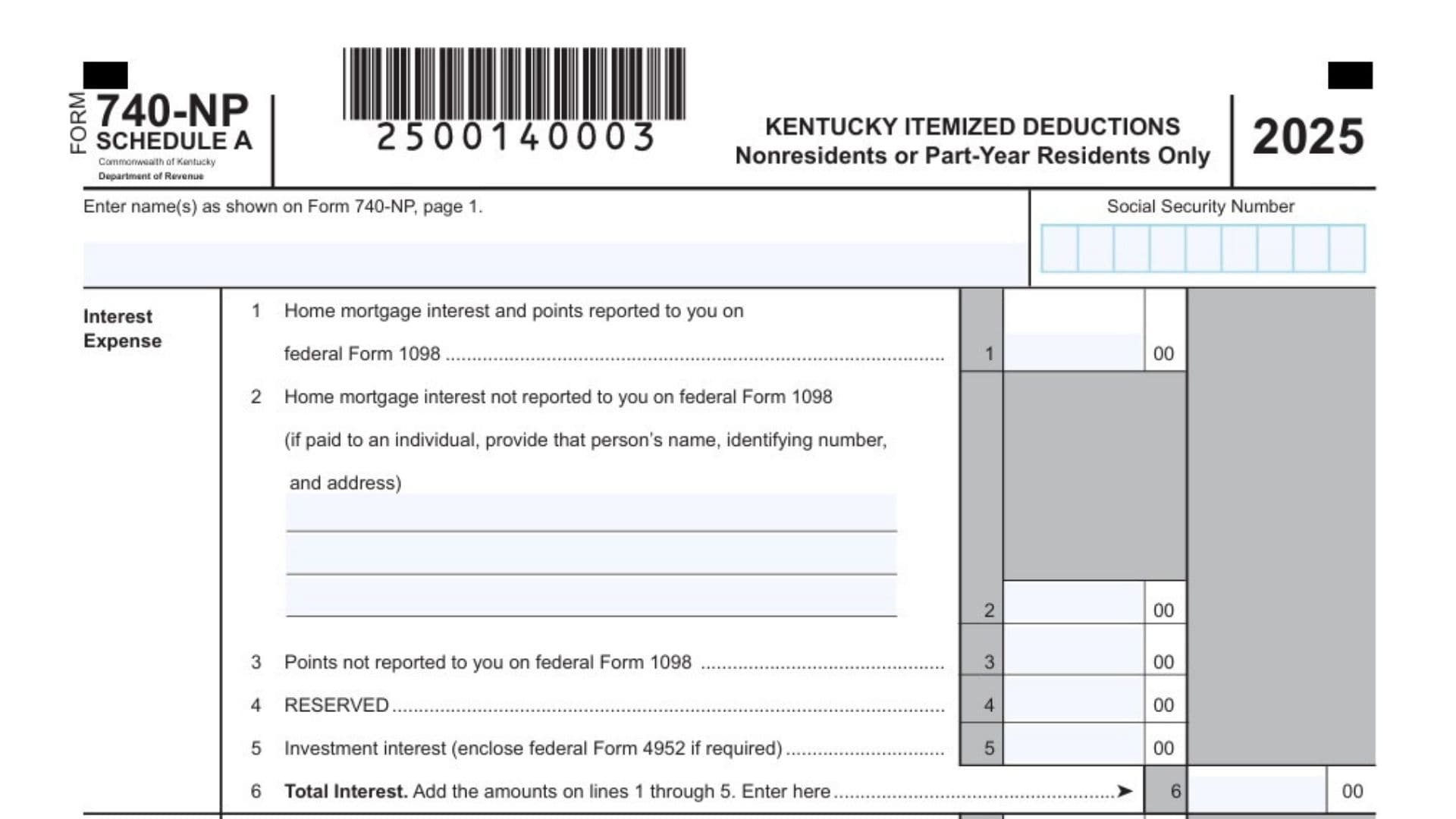
Kentucky Schedule A (Form 740-NP) is the itemized deduction schedule used by nonresidents and part-year residents who file Kentucky Form 740-NP and want to claim itemized deductions instead of the Kentucky standard deduction. This schedule is where you report eligible interest expense, charitable contributions, gambling losses, and certain other limited miscellaneous deductions that can reduce your Kentucky taxable income. One important point is that Kentucky allows you to itemize even if you did not itemize on your federal return, which gives some taxpayers more flexibility when deciding which deduction method is better. The amounts you enter on this schedule are meant to reflect your total deductions for the tax year, and in some situations those deductions are later divided or prorated on the Kentucky return. This form is especially important for married taxpayers, because if one spouse itemizes, the other spouse must itemize too. If a married couple files separate Kentucky returns, or if one spouse is not filing a Kentucky return, the deductions may need to be split using the income-based allocation section at the bottom of the form. In short, this schedule helps eligible taxpayers claim Kentucky itemized deductions in a structured way, but it also requires careful attention to documentation, deduction limits, and filing status rules so the final deduction amount is accurate.
How To File Kentucky Schedule A (Form 740-NP)
Complete this schedule only if you are filing Form 740-NP as a nonresident or part-year resident and you want to itemize deductions. If you prefer not to itemize, you may take the Kentucky standard deduction instead, as long as your filing situation allows it.
Enter your name and Social Security number at the top, complete each applicable deduction line, and then carry the final amount to the correct line of Form 740-NP. If you are single or married filing jointly, the total itemized deductions generally flow from line 14 to Form 740-NP, page 1, line 11. If you are married filing separately, or if your spouse is not filing a Kentucky return, you must also complete lines 15 through 18 to calculate your share of the deductions before entering the amount on Form 740-NP.
Keep records for every deduction you claim, especially charitable contributions and property donations. If a required supporting form applies, include it with your return.

How To Complete Kentucky Schedule A (Form 740-NP)
Header Information
Line 1: Enter your name exactly as it appears on Form 740-NP. If the return includes more than one taxpayer name, list the names in the same format used on the main return.
Line 2: Enter your Social Security number in the identification area at the top of the schedule. Make sure the number matches the number on Form 740-NP.
Interest Expense Section
Line 1: Enter the amount of home mortgage interest and qualifying points reported to you on Form 1098. This includes normal mortgage interest and eligible points connected to your home loan.
Line 2: Enter home mortgage interest that was not reported on Form 1098. If this amount was paid to an individual rather than a financial institution, include that person’s name, identification number, and address in the supporting information you keep or attach if required.
Line 3: Enter points not reported on Form 1098. This can include qualifying loan charges treated as points. In some cases, points must be deducted over the life of the loan, but if the loan was used to buy, build, or improve your main home and the usual requirements are met, the deduction may be allowed in the year paid.
Line 4: Leave this line blank. It is reserved and is not used for an entry.
Line 5: Enter deductible investment interest. This is usually interest paid on money borrowed for investment property. Do not include interest related to passive activities or tax-exempt income. If required, complete and include the federal investment interest form used to calculate this deduction.
Line 6: Add lines 1 through 5 and enter the total. This is your total deductible interest expense for this schedule.
Contributions Section
Line 7: Enter all qualifying charitable contributions made by cash or check. You may also include unreimbursed out-of-pocket expenses for volunteer work done for eligible organizations.
Line 8: Enter charitable contributions made in property rather than cash. If you donated used items such as clothing or furniture, use their fair market value on the date of the gift. If your total noncash contribution deduction is more than $500, you must complete the federal noncash contribution form. If the donated property value is high enough, an appraisal may also be needed.
Line 9: Enter any contribution carryover from an earlier year that you were not able to deduct previously because of income-based deduction limits.
Line 10: Add lines 7 through 9 and enter the total. This is your total deductible charitable contribution amount.
Other Miscellaneous Deductions Section
Line 11: Enter gambling losses, but only up to the amount of gambling winnings you reported on your federal return. You cannot deduct gambling losses beyond the amount of your winnings.
Line 12: Enter other allowable miscellaneous deductions. Only certain items belong here, such as federal estate tax on income in respect of a decedent, amortizable bond premium on certain older bonds, repayment under a claim of right exceeding $3,000, and unrecovered investment in a pension. List each type of expense separately in your records and enter one combined total on this line.
Line 13: Add lines 11 and 12 and enter the result. This is your total for other miscellaneous deductions.
Total Itemized Deductions Section
Line 14: Add lines 6, 10, and 13. Enter the total here. This is your full itemized deduction amount before any allocation between spouses.
Allocation Section For Married Taxpayers
Use lines 15 through 18 only if you are married filing separate Kentucky returns, or if your spouse is not filing a Kentucky return. If you are single or married filing jointly, enter the amount from line 14 on Form 740-NP, page 1, line 11, and do not complete this allocation section.
Line 15: Enter your income from Form 740-NP, page 1, line 8. This amount is used to determine your share of the total deduction.
Line 16: Enter the joint or combined federal adjusted gross income. This is the total income amount for both spouses used in the allocation formula.
Line 17: Divide line 15 by line 16 and enter the percentage. This shows the share of total combined income attributable to you.
Line 18: Multiply line 14 by the percentage on line 17. Enter the result here. This is your portion of the total itemized deductions. Also enter this amount on Form 740-NP, page 1, line 11.
What You Can Deduct
You may generally deduct qualifying mortgage interest, deductible investment interest, charitable donations to eligible organizations, gambling losses up to reported winnings, and certain narrow miscellaneous deductions. Kentucky also allows itemizing even if you used the standard deduction on your federal return.
Charitable deductions can include cash gifts, property donations, and some unreimbursed volunteer expenses. For mileage related to volunteer services, you may use the allowed charitable rate or actual gas and oil cost, along with parking and tolls if applicable.
What You Cannot Deduct
Do not include personal interest such as credit card interest, car loan interest, life insurance loan interest, delinquent tax interest, or interest on someone else’s debt when you are not legally responsible for paying it. Business interest belongs on the correct business schedule, not on this itemized deduction schedule.
For contributions, do not deduct political gifts, club dues, raffle or lottery ticket costs, tuition, the value of your time, gifts to individuals, or the value of benefits you received in return for a donation. Only the deductible portion of a qualifying gift should be included.
Recordkeeping Tips
Keep receipts, canceled checks, acknowledgment letters, and other written proof for every deduction claimed. For any separate charitable contribution of $250 or more, you should have written acknowledgment from the receiving organization.
For property donations, keep records showing what was donated, when it was donated, how the value was determined, and whether any conditions were attached to the gift. Strong documentation makes the schedule much easier to support if questions come up later.
Common Mistakes To Avoid
Do not skip the allocation section if it applies to your filing status. Many errors happen when married taxpayers enter the full deduction on the return without first calculating the proper share on lines 15 through 18.
Also avoid entering non-deductible personal expenses on the wrong lines. If a deduction does not clearly fit the category shown on the schedule, review it carefully before claiming it.